Showing posts with label fish. Show all posts

8 November 2015

You say tomatillo, I say tomato...

Spiraling quickly toward the end of gardening season, here's a bright late-harvest recipe for before the dutch oven gets dusted off.


Maybe not technically a posole, but a fantastic green tomato fish chowder (garnished with the world's smallest radish).

North Atlantic End-of-Season Posole

adapted from bon appetit October 2015 issue

1-3/4 lbs green tomatoes
2 tbsp olive oil
1 red onion, minced
2 cloves garlic, smashed then minced
1 fresh hot peppers, thinly sliced
all the cilantro that survived the first snowfall (or 1 cup)
2 cod loin fillets*
kernels from 2 cobs of sweet corn**
2 cups seafood stock***
garnish for serving: sliced fresh hot pepper, radish, lime

*yeah, okay, cod loins vary in size, but use enough to serve a decent soup-amount to 4 people... a pound to a pound and a half will do

**blanch very fresh sweet corn in boiling water for 4 minutes then plunge in ice-cold water to stop the cooking process; using a sharp knife, cut the kernels off the cob... or use a heaping cup of frozen corn

***made from fish heads and/or shellfish shells (ours was in the freezer made some time ago, likely from shrimp heads and shells, maybe trout heads or lobster scraps too)


True, we had to substitute nearly every ingredient, but that's just the
cost of living on an island in a cold, harsh climate.
Wash and quarter the green tomatoes, removing the stem and any unsightly spots, bruises, frostbite, etc.  Puree in a food processor or blender and set aside.

In a heavy-bottomed saucepan, heat oil over medium.  Cook onion, garlic and hot pepper until soft.

Add half of the green tomato puree and cook until the mixture reaches a good steady boil.  Add cod, corn, and seafood stock.  Bring to a simmer and maintain it to poach the cod until it is cooked through, about 8-10 minutes.

While the cod is cooking, roughly chop the cilantro and add to remaining green tomato.  Puree together.

When the cod is cooked, remove soup from heat and stir the green tomato mixture to incorporate, breaking the cod into chunks.  

Ladle into bowls, garnish with hot pepper slices and radish and squeeze a bit of lime juice over top.  

Serves 6 as a first course or 4 as a light meal.

~~~

Whenever we buy a gourmet cooking magazine, we excitedly scan the pages.  Ooooohing and ahhhhing.  Imagining a dinner party.  Looking up ingredients that are probably readily available in major cities but impossible to find on this island in the North Atlantic. Or at least impossible to find all at the same time.  (We fantasize constantly about grocery stores that you can walk into with a list and walk out of with everything ticked off.) 

It's possible there is some sort of psychotic disorder that makes us buy these magazines over and over again.  Taunting ourselves with them.  Salivating over meals we'll never eat.

Then this miraculous thing happened.  Flipping through the October issue of bon appetit, I came across a recipe for green posole with cod and cilantro.  Brilliant, I thought, I can make this.  "Did you see this?" I called out excitedly, "We have cod! We can make this!"

"We don't have tomatillos," Fefe Noir, all sensible-kill-joy about her says, "and where will you find hominy?  What is hominy?"

Pffffffttt... details...

This year's garlic harvest chez The Moose
Curry Experience, curing in Fefe Noir's office.
This is a great recipe for November on Newfoundland's Avalon peninsula, as we are spiraling quickly toward the end of gardening season.  The garlic has been harvested and cured, the cilantro is still hanging on.  Peppers are finally ripe, or ripe-enough at least.  The first snow means we have had to give up on the vague hope that the tomatoes are going to ripen outside, so they have been brought in, green, to be hung to ripen, or stored in dark boxes, or made into jam and salsa and chutney.

I know, green tomatoes are not tomatillos, but they are bright with lemony-acidity which is a great base for a fish soup.  And sure, shallot season is over and I hadn't thought far enough ahead to buy some for storage but red onions are strong and juicy right now... and okay, the cilantro that is hanging on has gone to seed but the feathery green on the flower stalk tastes as much (maybe even more) of cilantro herb as the broad flat mid-summer leaf.  In the end I couldn't find hominy, but we had blanched and frozen a bit of local sweet corn.  Clam juice, too, is clearly for fancy people with fantasy grocery stores, but seafood stock is simple to make.

In the end, I'm pretty sure this is no longer a posole, but it is definitely a really good soup.  


11 June 2015

Why They Call it Fishing...

In which caribougrrl remembers how to cast a line, practices her birding skills, and is reminded why it's called fishing (not called catching).


It looks like a good spot to fish, right?  Or does it not? 

5:00 AM: I finally relent to the pacing and whining dogs and get up to feed them.  Every morning, starting at about 4:15, the dogs start to worry that I will forget to give them breakfast. This is a completely normal start to my day, every day.  But today is fishing day.  And it is pouring with rain.  POURING.  I know, technically, that you can go fishing in the rain.  I think, perhaps, it might even be the best weather for fishing.  Did I mention POURING with rain?  I feed the dogs, double check all my gear.  Wonder if I have enough snacks.  

5:20 AM: It is still pouring with rain, so I go back to bed.

6:15 AM: Fefe Noir wakes me up to tell me it stopped raining.  I admit this news feels a little disappointing.

A re-enactment of the thoughtful gesture of leaving coffee
in a thermos so it will still be hot when Fefe Noir finally
wakes up.  The cats do not take artistic direction well and
refused to participate in the staging.  Sam showed slightly
more compliance but insisted on ennui rather than
blissful sleep.
6:35 AM: Standing in the hallway in my rubber boots, I realize that in the event I actually catch a fish, I want something to stun it with before bleeding it.  I rifle through the toolbox.  I realize that in the event I actually catch a fish, I might also want grippy gloves to hold on to it.

6:45 AM: At the local gas station, I buy a couple of cheap pairs of rubberized gloves.  I resolve my snack issue by buying a chocolate bar: dark, with nuts, so I can imagine it counts as a healthy breakfast.

7:05 AM:  I am back at the house because I discover I left without making coffee.  What?

7:15 AM: I leave a thermos of coffee and a mug on the bedside table next to a snoring Fefe Noir.  One of the dogs and at least one cat have stolen the warm spot I left.

7:20 AM: While I drive, I consider the options in my tackle box and make a plan.  I remind myself about the things I tend to forget when casting, like pinning the line down before releasing the spool.  Um, like releasing the spool, at that.  I am in good mental form, visualizing the entire process. 

7:25 AM:  I turn down Fisherman’s Road and think this is a sign.  Then I think it is in fact, literally, a sign.  I no longer know what to make of it.

When caribougrrl turns the car onto Fisherman's Road, she takes it as a sign.
7:45 AM:  As I approach my selected fishing spot, I review in my mind all the advice I have gotten: stay away from beaver ponds, find a beaver pond, work the pools in a river, trout go after the egg-like lures in the spring, worms are best, minnows are best.  Suddenly I stop in my tracks and think, “Where is my fishing rod?”

8:05 AM: I do not find the fishing rod in the car.

8:15 AM: I find the fishing rod leaning against the wall by the front door, right where I left it so that I wouldn’t forget it.  Not a creature is stirring.  Not one.  No one seems to notice I have left the house and come back.  All I can hear is snoring.

caribougrrl decided to try her luck in the streams because
even though it's June, it's so early in the season, the alder
catkins are still out and the leaves are only starting to unfurl.
8:25 AM:  Heading from the car with fishing rod in-hand and a strong sense of deja-vu, I pick out the Oh Canada song of a white throated sparrow.  On the way to the fishing hole, I am amazed by the deafening level of bird song. 

(I am more amazed that no matter how many birders I’ve spent time with and how many hundreds of collective hours they’ve spent trying to teach me stuff, I am terrible at bird identification.  White throated sparrow and black capped chickadee are the only ones I feel confident about by ear.  And I’m not convinced I would know the sparrow by sight.)

8:45 AM:  I debate between a float and a sinker to go with my hook and fake egg.  On the one hand, the egg is supposed to float.  On the other hand, I am worrying about whether the float has enough weight to allow me to cast.  I decide on a small sinker but two glo-eggs.  The stupid squishy looking fake fish eggs are really difficult to jam on the hook and they smell weirdly like diesel fuel.  I cannot imagine how this might be attractive, but then again, I am not a trout.  In the end, I only put one on because I can’t face doing it twice.

8:55 AM:  I struggle to dredge up the muscle memory I need for casting.  Every few attempts, nothing happens, the line doesn’t leave.  In between the times I forget to release the spool, I spend a lot of time untangling.  Eventually I find my rhythm.

9:25 AM: I become aware of the black flies lined up under the rim of my hat and along my collar.  I decide the eggs aren’t doing it.  I inspect the tackle box and consider the big white grubs but switch to a wiggly thing with glitter on it.

caribougrrl brought a sampling of tackle with her; since she doesn't really
know what she is doing, she just brought the bright and shiny things... 

9:50 AM:  As much as I am enjoying casting and reeling, casting and reeling, casting and reeling, I have not actually seen any fish.  I have not even seen any signs of fish.  No jumping, no unexplained ripples on the surface of the pool… other than an ancient faded empty Vienna Sausage tin, I have not even seen any signs that anyone else has maybe ever stood here trying to catch fish. 

9:55 AM:  I am itchy where a black fly dug a hole in my finger, right on a knuckle.  The swelling is making it difficult to bend the finger.  I curse at the cloud of black flies surrounding my head even though I know this particular bite is from a couple days ago.

9:57 AM: I decide that probably the trout are already out of the streams and back in the ponds.  I know this decision, though it feels full of authority, is based on nothing but unjustified conviction.  I have no idea what I’m doing.

Or maybe the leafing out of the alder means the trout -- clearly
not in this stream -- are already in the ponds?  Maybe?
10:00 AM: As I am packing up my gear, I stick my apple into my pocket so it is handy for the walk.  I decide to head to the far side of the beaked hazel grove.  If I remember correctly, there’s a pond there that looks like a spot where people go to fish.  I recognize the only reason I think people fish there is that the trail leading to it is an ATV track.

10:05 AM: I dig the chocolate out of my pack and eat it.

10:20 AM: As I’m walking I see that the ferns in this area are still young enough to pick as fiddleheads.  We don’t have fiddleheads proper here in Newfoundland but Peter Scott assures us that these other not-quite-fiddlehead ferns are edible.  I know from experience, however, that by edible he does not mean palatable.  I keep walking.  I suddenly hear a racket… no, a volley of noise.  Tattatatatatatatatat tattattattat.  Like gun shots, but not quite… maybe a nail gun? Or a toy gun?  It’s relentless and getting louder.  I find myself surrounded by yellow warblers, darting around madly with no apparent purpose. 

(Let’s be honest. These might well not have been actual yellow warblers… they could have been any one of the “Confusing Yellow Warblers” in the Peterson guide.  Or maybe even some other sort of small yellow woodsy bird.  Not even a woodsy bird necessarily, it’s more like scrub land.  The only thing I am certain of is that these were not american goldfinch.)

10:25 AM:  Standing where I expect to find the trail that winds itself down to the pond, I am surprised to find a construction trailer.  And a leveled-out bit of land.  When did that happen?  I worry about the beaked hazel but I can’t tell for sure if it’s in or out of the construction footprint. Not really keen on the idea of meandering blindly toward an unseen pond, hoping to cross the trail somewhere past the development, I decide the trout are probably still in the river.  I mean, it’s been a slow spring, and still pretty cold out.


There used to be a trail here, one that wound it's way down the hill toward
a lovely pond.  Probably brimming with trout.

10:35 AM: Working my way back to the car, I stop and flick my line out into a few more river pools.  Nothing.  Well, I snag a couple of rocks and thus have a couple of milliseconds of mild excitement, but no fish.

10:50 AM:  I have not needed my gloves.  I suppose I have not needed my rod either, but there’s no way of knowing without it.

20 May 2015

Smokes Like a Fish, Drinks Like a Chimney

There is something of a poetic northern-ness in a sauce made with smoked fish and vodka. Skål! 


Rose pasta sauce with smoked fish on homemade pasta.  Other than vodka, without the trimmings, is there a better way to get through the end of pantry and freezer season?


Smoked Fish Vodka Sauce with Fettuccine


2 tbsp olive oil
Use a vodka with some flavour in it, none of that invisible
stuff you bought in your teens early 20s.

10 cloves garlic, smashed (or less if you are afraid of garlic, but this really isn't overly garlicky)
2 dried red chili peppers
6 plum tomatoes, peeled and diced
4 tbsp vodka
1/4 lb of smoked char (or substitute with smoked salmon or trout), torn or crumbled into small bits
4 tbsp heavy cream
1 tbsp butter

a three-egg batch of hand-made pasta, cut in fettuccine (or wider) size


In a large skillet, heat olive oil over medium.  Add smashed garlic and chilies.  Cook, stirring, until the garlic is softened.  Increase heat to med-high and add chopped tomatoes.  Bring to a boil and reduce heat to med-low.  Stir occasionally until reduced by about a third.  Add vodka, and continue to let the sauce reduce.


Don't worry about precise chopping or mincing of
ingredients, not only will it all cook down to mush, but
you're going to blend it up anyway.
Put a big pot of water on for your pasta. (If it boils before you are ready for it, turn it down to a simmer until you are ready.)

When the tomatoes are mostly broken down and the sauce looks thick, remove from heat.  Allow to cool enough to puree in a blender.  If you are fastidious, wipe your pan clean and pour sauce back into it through a sieve.  If you can tolerate a more rustic sauce, just return the blended sauce to your skillet.
Bring back to a slow boil after adding the smoked fish, then
reduce the heat and stir in the cream and butter.  Once the
butter is melted and it's all nice and evenly combined the
sauce is ready.

Re-heat the sauce over medium. When it starts bubbling, stir in the smoked char. Cook the pasta now.  When the sauce to returns to a consistent bubble, reduce heat to low and stir in the cream and butter.  When the butter is melted and the cream is combined remove from heat.  This should happen about the same time your pasta is cooked.  Stir a wee bit of the pasta water into the sauce for good measure.  Drain the pasta and serve with sauce.

Makes 4 large or 6 moderate servings.


~~~

I like this sauce for poetic reasons as well as gustatory ones.  Although it's roots are admittedly in penne alla vodka, it's a great pasta for northern latitudes: smoked fish and vodka.  This is not a light meal, but it's not so heavy it will put you into a coma either. Good comfort food for the distressingly cold evenings we're still experiencing here.  In May.


You can almost smell the smoked char through the computer screen, can't you?  To serve, garnish with chive (admittedly, chive is, in fact, growing already) and some old hard Italian cheese like Sovrano.

We emerged from a few weeks of fog into a stretch of sunshine, so at least we're starting to build stores of vitamin D again.  Back to fog for a few days, but sun promised in the long-range forecast.  It's all a bit maddening even when the sun is shining because it looks like summer... as long as you are looking at the sky and the sea, and not at the brown hills and the leafless trees.  Yet, ridiculously, I may need to mow the lawn tomorrow for crabgrass control, but none of the desirables are out yet.*  Definitely still pantry, freezer and booze season.

*Okay, that's not technically true. The garlic is coming up nicely and just this morning our rhubarb started to leaf out.  Early flowers like snowdrops, crocus and alpine primrose are out.  But seriously, it's mid-May already.

Make hay and all that.  We'll still head out into that brilliant light, completely under-dressed for what turns out to be a very frigid coastal hike.  We'll blame the icebergs for this instead of poor planning, but we all know the ocean will be cold for months still and the chilly onshore breeze will be welcome in July.  We'll go out to garden, and be too hot with the sun on our backs, stripping down to t-shirts... until we stop moving anyway and need to pile sweaters and gloves back on.  We'll wear our sandals, even though our toes are frozen, because for two full hours one afternoon sometime last week it was warm enough to get them out and now, dammit, it's sandal season.  We'll sit out on the porch wrapped in blankets because we want to have just one beer outside.


They make really good smoked char up in Nain, Labrador.
The only real proper evidence of spring is that trout season opened on the weekend.  And although I swear the best fish for this recipe is smoked char from the Torngat Fish Producers Co-op of northern Labrador I suppose some of your home-smoked trout** would work too.

**If you want to send us some of that home-smoked trout, we'd be happy to try it out for you before you make it... you know, just in case I'm wrong...

8 February 2015

Freezer and Pantry Valentine: Part 1. The Appetizer

Make an impressive three course meal for two for Valentine's Day using ingredients you already have.  For the appetizer, smoke your own fish and make pickled berries.  (I told you it was impressive.)


Frozen fish, frozen berries and stale bread make a smoky and bright appetizer worthy serving to the love of your life.
Tea-smoked Cod Crostini

For the tea-smoked cod:

frozen cod*, thawed (as much or as little as you have**)

*Don't have cod?  Don't worry... use whatever other fish you have in the freezer. Allergic to fish? Tea-smoke a couple eggs (boiled for 6 minutes, peeled and cooled first), or pull something else out of the fridge or freezer.  You can tea-smoke just about anything, but consult the miracle of the internet for appropriate cooking times.

**As long as it fits on your smoking rack, see instructions below.  And bearing in mind this is for an appetizer for two, so you don't need very much... of course, any you don't use for Valentines day would be good on a sandwich or salad the next day.


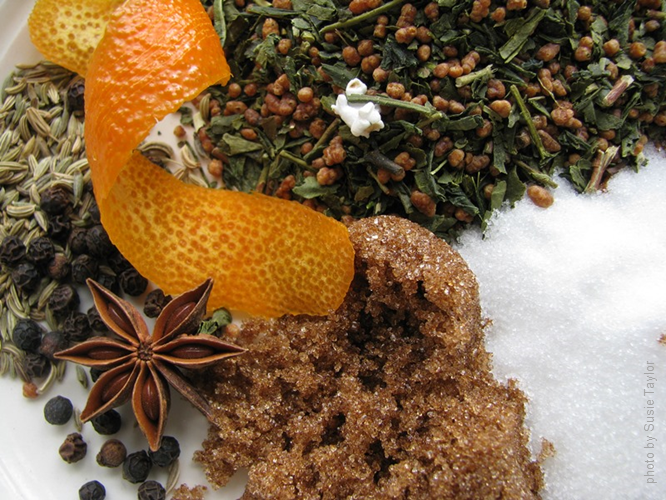
Genmaicha tea comes with the rice already in it, but feel
free to substitute any leafy tea and raw or toasted rice.

4 tbsp genmaicha tea (or 2 tbsp loose leaf green tea + 2 tbsp uncooked rice)

1 tbsp demerara sugar
1 tbsp granulated sugar
1 star anise
1/2 tsp fennel
1/2 tsp peppercorns
1 twist of orange

For serving:

a couple slices of stale bread
butter***
quick-pickled red currants****

***Or olive oil or bacon grease or drippings...

****Any berry from your freezer will do, the tarter the better.


MAKE AHEAD: You probably don't want to be running around like a crazy person feeling harassed and frustrated on Valentine's Day.  So make the smoked cod and the quick-pickled currants the day before.  We did a one-quarter-ish recipe of the Pickle Girl's recipe (link above) for the currants... and used the excess brine and pickled some wild blackberries to eat with cheese.

You need a heavy dutch oven or casserole or other pot with a lid.  You also need a good bit of aluminium foil and a heatproof rack that fits inside your pot.  We used our cast iron dutch oven and an old metal trivet with a bent leg (caribougrrl finally wins the why-are-we-keeping-all-this-useless-stuff game!).

When you see wisps of smoke rising from the tea mixture,
it's time to put the fish on.

Line your pan with tin foil in two directions, leaving a lot of overhang on all sides (enough to wrap the lid in later). Mix the tea, sugars, and spices together.  Spread these across the bottom of your foil-lined pan, add the orange peel, and place the rack over top.  Heat the smoking ingredients over medium-high until wisps of smoke begin to rise.  Put the fish on the rack in a single layer, put the lid on the pot, and wrap the lid with the overhanging foil.
Seal up the pot with tin foil turning it into a stove top smoker.


Let the fish smoke***** for about 12 minutes per inch of thickness.  You can tell if it's cooked the same way you would if you were baking or grilling it: the fish will be firm and fat will be coagulated on the surface.  White fish is delicate so remove it from the pan to cool rather than allowing it to cool in the smokey pan.

*****Your house is going to smell a bit smoky, but fragrant smoke, like incense.  Go ahead and run your exhaust fan, but there's a lot less smoke than you think, especially if you've used enough foil.  If you're still worried about it, take the whole pot outside when you open it up.


To serve:

Cut your stale bread into serving sized pieces.  For bonus points, cut it into heart shapes.  Butter (or oil or grease) lightly and fry in a skillet to toast.

Top toasts with flakes of smoked fish and a few pickled berries.  The bright and salty berries are the perfect counterpoint to the rich, smokey fish.


The tea-smoked cod is done when it's firm and flaky, and the fat has coagulated on the surface.

~~~

So, you might glean from the all the notes, that the important thing is not following the instructions exactly so much as using what you already have on-hand and following the idea.  Save your money for one good ingredient for your main or for a really good bottle of wine or for flowers, or (let's be honest) for your heating bill.  The point is, you can probably make something fantastic with things you already have sitting in your freezer and your cupboards.

About the tea-smoking.  We bought Skye Gyngell's A Year in my Kitchen several years ago and have always been tempted by the tea-smoking technique but really intimidated by it too.  When I saw the step-by-step in Showfoodchef's post about tea-smoked salmon, it all suddenly made sense and seemed accessible enough to try.  As it turns out, not only is tea-smoking possible, but it's surprisingly easy and surprisingly tidy.  Give it a try, you'll be amazed by yourself.

Stay tuned for a miniature version of a classic main, perfect for candle lit dinner.


10 August 2014

Newfound-Ceviche

We're at the tail end of the summer food fishery.  Put away your pans and deep fryers and let the last of your fresh cod cook itself in the refrigerator.


In this ceviche, the cod and scallop are cooked by the acid in the liquid.  That means you don't have to heat up your kitchen; a bonus during the dog days of summer.


Cod & Scallop Ceviche


1/2 lb fresh or thawed cod, chopped coarsely
1/2 lb fresh or thawed scallops, chopped coarsely*
3-5 cloves garlic, smashed and coarsely chopped
2-5 (or more) hot red peppers, cut in half lengthwise
1-1/2 c. chopped fresh cilantro
1 tsp coarse sea salt
4 limes, juiced
1/2 grapefruit, juiced
Use sea salt in this recipe because, well, the sea is where
the star ingredients come from.
2 tbsp silver tequila
Use glass or other non-reactive material.  Jars work well
because the high sides help reduce the amount of citrus
juice required to cover everything.

*if you use tiny bay scallops, don't bother chopping

Once all the prep work is done, this recipe is dead simple.

In a clean 1 litre glass jar** spread 1/5 of the cilantro, garlic and peppers over the bottom.  Top with 1/4 of the cod and scallops.  Add another layer of cilantro, garlic and peppers and 1/4 tsp of salt.  Continue to layer the fish and seasonings, ending with a seasoning layer.

**or use a glass bowl but you may need additional citrus juice to cover the fish; the tall narrowness of a jar helps minimize the amount of juice required... and with the price of limes this year, it's a definite advantage


Use a spoon handle or knife along the edges of the jar to
release pockets and bubbles of air.
Mix the lime and grapefruit juice with the tequila.  Pour into the jar.  This will cover or nearly cover your fish. Run a knife or spoon handle around the edge of the jar to release air bubbles.  If the fish mixture is not completely covered in liquid, add more lime juice.

Cover and refrigerate for 12-36 hours.  Check that the fish and scallops are opaque right through before serving (if not opaque, return to fridge for a few more hours).  How quickly the ceviche will cure depends on how cold your fridge is, how acidic your citrus fruit was, and how big your coarse chopping is.

Use a fork or slotted spoon to remover from jar and serve on grilled sweet potato slices (see below).

Reserve the curing liquid and mix it into fresh salsa the next day.


Grilled Sweet Potato Rounds


sweet potatoes 
drizzle of sunflower oil
pinch or two of salt


Discovering that sweet potato can be cooked directly on
the grill was a culinary epiphany of the best sort.
Pre-heat your grill scorching hot.

Slice sweet potatoes into 1/4" thick rounds.  Toss with oil and salt.

Put sweet potato rounds directly on the grill in a single layer and immediately turn the grill down to medium heat.  If you have a charcoal grill or are using a griddle, use your own judgement with how to manage this shift in heat, I have no advice.

Cook for 4-6 minutes on each side.  You want the outside to blister and char a bit and the potato to cook through.  Salt lightly as you take them off the grill.

These are perfect as a base for ceviche, but are also good as a side for pretty much anything (and a simple but seriously delicious way to get your orange vegetable for the day).


~~~


Although this is not exactly an authentic recipe, it's inspired by the Peruvian style of ceviche with hot peppers and served with sweet potato.  It's best with sweet potato, but grilled avocado will also do in a pinch...
~~~

Summer in Newfoundland is always busy.  For starters, you can never be sure how much of it you'll get, so as soon as the weather turns you drop everything else and concentrate on summer: coaxing food out of the back garden, outdoor house projects... running, cycling or hiking without multiple layers, driving with the windows down, synthesizing vitamin D... turning the heat off in the house (at least during the day), whale watching, cocktails on the porch... and most importantly, after months of complaining about the cold and the damp and the unfairness of it all, finally taking a deep breath and saying, "it's too damned hot".

The other thing about Newfoundland summer is that, as astounding as it may seem for the foggiest place on earth, this island in the north Atlantic is something of a vacation destination.  Some years, before you know it, you are blocked solid with visitors.***

***Now don't take that as a complaint.  Visitors give us the excuse to do touristy things and the opportunity to show off some of the off-the-beaten-path secrets of this place.  And conscripting house guests to a work-for-your-food scheme**** resulted in speedy progress on The Fence Project, a good start on The Window Restoration Project, and knocking a bunch of items off the Round-To-It List.

****That sounds a bit cruel, I suppose, but in the interest of full disclosure, these particular guests insisted they wanted a project to work on... 

This has been a Summer of Visitors, thus a summer of especially good food.  (We can't have it be said that anyone ate poorly chez The Moose Curry Experience.)  It's been tricky though, since the fish truck that used to live across the harbour closed a couple years ago and the fish truck we stumbled across last year did not reappear this spring.  We were scrambling to find seafood closer to home than St. John's*****.  After many driving excursions wild goose chases, a failure of the power of social media, and some disappointingly not-as-fresh-as-it-should-be purchases from big chain groceries, we finally found a place hiding right under our noses.  Some good old fashioned postering brought the recently opened Admiral's Market to our attention.  If you're in Conception Bay North, you can find them in the boat-shaped building at the southside marina in Harbour Grace.  Both the scallops and the cod used in this dish were bought from the fabulous women who run the market.


Fresh cod and fresh scallops were bought locally from Admirals Market.
*****There are some good fish shops in St. John's and since I work there, it's not always inconvenient, but it means not being able to decide on a holiday or Saturday that it feels like a mussel night... plus, there's something nice about being able to spend your money in the community where you live.

To be frank, I was hoping to write a blog post about catching our own cod during the food fishery.  But that's a one-that-got-away story.  Er, a one that never bit story.  (Anyone who wants to help improve some mainlander jigging skills in September should leave a comment or send an email to the.moose.curry.experienceATgmail.com!)

Although the cod fishing was a bust, it's been a Summer of Perfect Cilantro.  Serendipitiously, Fefe Noir had the foresight to order several pounds of coriander seed this year and sow it in the bed where we buried the not-quite-composted bits from the old composter.  As a result, we have a serious bumper crop of cilantro.  Despite the unbearable heat (for those of you who will take pleasure in mocking our weather intolerance, we had about 3 weeks in the mid-high 20C range), there was no massive bolting event.  


Our cilantro crop is phenomenal this year.  Too bad none of our guests were as enthusiastic about it as we are...

An amazing cilantro year.  And five or six weeks of guests who don't particularly like cilantro.  Or very hot peppers.  Or very much raw garlic.

So as soon as the house was empty we started chopping... 


18 April 2014

Worth Its Salt Fish

The classic pairing of salt cod and parsnip... turned pub grub.


The classic coupling of salt cod and parsnip becomes a variation on the much-loved meal of fish & chips.


Seed-Crusted Salt Fish with Parsnip & Carrot Chips


for the fish:

salted cod, center loin section, skinned (for each person, a piece about the size of a pack of cards, give or take)
all-purpose flour
egg, beaten
about 1/4 c. each sunflower seeds and pumpkin seeds (hulled) for every 2-3 pieces of fish


for the chips:

1 carrot per person
2 parsnips per person
ice cubes


oil for frying (peanut and/or sunflower)


for the vinaigrette/ dipping sauce:

1 small shallot
a generous pinch of salt
4 anchovy fillets
1/3 c. balsamic vinegar
juice of 1/2 lemon
3/4 c. good olive oil


TWO OR THREE DAYS BEFORE COOKING

Soak the salt cod in a large bowl of cold water.  Change the water twice a day (more if you think about it more often).  You may have heard that you can speed up the removal of excess salt by boiling the fish, which is true, but it will fall apart... that's okay for fish cakes or brandade, but you want to keep this fish intact; take the time for a cold soak.


A COUPLE OF HOURS BEFORE COOKING

Drain the salt fish and let it sit in a colander or sieve to drain and allow the surface to dry somewhat.

Cut your carrots and parsnips into long, thin sticks (about 5-6 mm wide; closer to an allumette than a julienne).  You want them to be fairly even, but don't get bent out of shape about it; a little variation is good, it means your food will look hand-made.  Anything really badly misshapen can be fed to your dogs as treats.  Put the cut vegetables in a bowl of ice water (mostly ice), and let them sit long enough to curl up a bit.


Cut the carrots and parsnips into sticks, a bit thinner than a snacking carrot stick, but thicker than a julienne.  Soaking them in ice water will give them a bit of a curl. 

Now is a good time to make your vinaigrette.  This will make way more than you need for your salt fish but don't worry about leftovers, you'll use them (salad dressing, drizzle for lamb chops, mixed into lean ground meat for burgers, sauce for steamed or poached fish, dip for fresh bread...). 

Roughly mince the shallot.  Sprinkle with a pinch of salt and use the blade or handle of your knife to press or grind the shallot into a paste on your chopping board.  (If you have a mortar and pestle, feel free to use that fancy high-tech equipment instead.)  Roughly cut anchovy and then work the fish into the shallot paste.  Scrape the paste into a small mixing bowl and whisk in remaining ingredients.  I like vinaigrette to remain separated so I don't whisk to emulsification, just enough to combine well (it looks nicer if you don't mind stirring it up every time you use it).  Let sit at room temperature until serving, allowing the flavours to mingle.


WHEN YOU ARE HUNGRY

Crusting the salt cod with pumpkin and
sunflower seeds is messy, but definitely
worth the effort.
Drain your carrots and parsnips.  


Get out three shallow bowls and a plate.  Line them up on your counter.  Put flour in the first bowl, beat an egg in the second bowl and mix the seeds in the third bowl.

For deep frying, you need the oil deep enough to submerge your food, but you also need to leave a 3-5 cm gap at the top of the pan to accommodate the volume of your food and some bubbling-up.  Choose a pan with this in mind (also paying attention to how much oil you have).  


Heat oil over medium to med-high heat.  The oil is hot when you can see long streaks in it and when bubbles rise up swiftly but not vigorously when you press a wooden spoon handle against the bottom of the pan.  If you refuse to fry without a thermometer, aim for about 365-370F.


Working in batches as necessary, gently lower your carrots and parsnips into the oil and cook until they are a light golden brown (about 6-8 minutes).  (Don't over do it, these are going back in the oil just before eating.) Remove and let them drain in a metal sieve over a heat-proof bowl or spread across brown paper.


While the carrot-parsnip-fries are cooking, crust your fish.  Dredge in flour, then coat with egg.  Let the excess egg drip off, then press the fish firmly into the seeds.  Crust all sides with as much seed as will stick.  Lay flat on the plate.  Crusting the fish is messy and your fingers will feel gross from being stuck with egg and seeds.  If you have someone willing to help, delegate this job to them and be prepared with a bunch of encouraging things to say.  (Don't forget to check your fries once in a while.)


While the carrots and parsnips are draining, cook your fish.  Submerge in the hot oil and cook until the seed crust looks well toasted, about 4 minutes.  Remove to a metal sieve over a heat-proof bowl or drain on brown paper.

While the fish is draining, return the carrots and parsnips to the oil for about 2 minutes.  The golden brown colour should intensify.  Remove to drain.   Salt while they are still piping-hot and toss to coat.

TO SERVE

I am convinced that fish and chips is a meal best shared from a common plate and eaten with your fingers. So cover your table with a few layers of newspaper (lots of layers for this meal, see note) and tip the fries and fish onto the surface.  Whisk your vinaigrette and serve on the side for dipping or use a spoon to drizzle over the fish & chips.

(If you decide to serve on individual plates, put a couple of layers of newsprint or brown paper on the plate.)


NOTES

Salt cod does not taste like fresh cod.  It has more presence.  This fish is fantastically delicious with the earthy crunchy seed crust matching the intensity of the fish... but if you are expecting something like fresh or frozen cod, you'll be too surprised to fully appreciate the dish.

The carrots and parsnips are sweet and punchy with flavour, but oily.  Totally moreish, but be sure to have a thick layer of paper under them.  

~~~

A few years ago, an issue of La Cucina Italiana had a recipe for a seed-crusted salt cod appetizer.  There seemed to be a million different kinds of seeds that we didn't have in the house at the time.  We didn't have salt cod in the house either... it's possible I still thought salt cod was only good for fishcakes then. 

But I loved the idea of it.  I've been thinking about that fish for three years.

Salt cod has a particular cultural importance here in Newfoundland (I might bore you with the history another time, but not now), and you can buy it anywhere.  It's for sale in grocery stores, road side fish trucks, vegetable stands... I've even seen salt cod for sale at gas stations and craft shows.  When we first moved here I couldn't understand why anyone would purposefully choose salted fish over fresh or frozen cod.  It took me a ridiculously long time to overcome my baseless mainlander snobbery around salt fish, but I'm glad I did.

Here's the thing about salt cod: it's not fresh cod.  You can't expect to use them same way.  It's not a choice of salted or fresh, you pick the one you need for the task at hand.  Salt cod is dense and concentrated, and even well-soaked, it bites back; but that's precisely the beauty of it, not the problem.  Making that psychological leap changed everything.   

A couple weeks ago, Fefe Noir heard a radio program mentioning that Romans traditionally paired salt cod with parsnip.  You know that lovely feeling of epiphany, that moment when suddenly everything seems to make sense?  It was like that.  Salty and intense fish matched with the ethereal sweetness of winter parsnip... of course.  Which brings us the second plate in our fish and chips project.


31 January 2014

An Act of Cod: Indian-Spiced Fish & Chips

An old standard finds enlightenment. 


Fish & chips is an unpretentious meal so cover your table in newspaper, gather everyone around and simply tip the food onto the table.  Eat together, with your fingers, from a shared pile of food.  Trust me.


Pakora Fish & Chips

a note on time management: If you do everything at once, it can take a few hours to prepare this meal (several things need to wait between prep and use). You can break up the work over a few days, doing the prep when it's convenient. The tamarind sauce can be made several days before or can be done the day of; same for the garam masala. The pickled onion should be made at least a couple of hours before serving to allow it to mellow; the potatoes need at least couple of hours in ice water, so prep these at the same time. Both can be made up to a day ahead. The batter needs to sit for a while before using, so mix up the batter and set aside while you do the first fry of the chips, batter and fry the fish (which will stay hot longer than the chips) and then do the second fry for the chips.  I know it sounds complicated, but stay with me, it's worth it.  If your kitchen is better stocked with tools than ours, it might even be easier than I'm letting on.

for the tamarind sauce:

1/2 lb tamarind pods
4 dried hot cherry peppers
boiling water
2 tbsp demerrara sugar (or more, to taste)
1/2 c. cold water (or more, as needed)

Put the tamarind pods and dried peppers in a heat-proof bowl and pour boiling water over them to cover. Cover the bowl with a plate and set aside to let soften. Do some laundry, take the dogs for a walk, change the bedsheets, dig out all your paperwork for filing your taxes... anything... but don't worry about the tamarind for an hour or longer. Run the tamarind mixture through a food mill to separate the skins and seeds from the pulp. This will result in a thick and sour paste. Dissolve demerrara in about 1/2 c. of cold water and stir into the paste. Continue to thin with cold water until it reaches the desired consistency (slightly thinner than commercial ketchup). Use right away or store in the refrigerator until you need it.

for the quick-pickled onion:

1 red onion
juice from 1 lemon
salt, to taste

Thinly slice the onion. I use a mandolin because evenly thin slices make me happy; but slice it in a more rustic manner if you like. Pack the onion into the bottom of a glass jar and add lemon juice and salt. If the onion is not completely covered, you can stir it once in a while or if you are lazy like me, just add more lemon juice or pack the onion down more tightly to cover. Set aside leaving at room temp for at least two hours or store in the fridge if you are leaving for longer than the afternoon.

The spices are toasted when they deepen in colour and become
immensely fragrant. You can buy pre-made garam masala as a time-saver
but you will be so pleased you made your own.


for the garam masala:

2 green cardamom pods
3 black cardamom pods
1/2 tbsp whole cloves
2 tbsp coriander seeds
2 tbsp cumin seeds
1 tbsp black peppercorns
6 pieces mexican cinnamon bark (or 1/2 stick cinnamon)

Combine all spices in a dry cast-iron skillet. Heat on medium-high (err on the side of medium... I think of this as south-southeast on my stove knob) stirring or swirling them around in the pan occasionally while heating. When spices become very fragrant and slightly browned, remove from heat. Continue to stir once in a while as they pan cools down. When they are cool enough to handle, grind the spices in a spice grinder (do them in batches as needed). Store them in a glass jar but do not cap until completely cooled.


for the chips:


1 medium-sized potato per person
peanut and/or sunflower oil for frying*
salt
nigella seeds (jeera)


*see notes in the fish section on choosing your pan and checking the temperature

We used Emeril Lagasse's technique for french fries. Before working on the fish, cut your fries and get them soaking... leave them soaking until you have the fish batter mixed.  Do the first chip fry before cooking the fish and the second chip fry after. When you remove the chips the final time, put them in a sieve suspended over a heat-proof bowl to drain the oil. While they are still piping hot, sprinkle them with salt and nigella seeds and toss to coat. The nigella seeds lend a je ne sais quoi that you don't want to skip.


"It came in this morning, love.  Landed yesterday."


for the fish:

1/2 lb. fresh local white fish per person 
1-2 tbsp garam masala
salt

We used cod because locally-caught wild cod is in season, also cod is delicious, but buy whatever local sea or freshwater whitefish is best where you live.

adjust the batter ingredients as necessary, but for 2 lbs of cod (4 servings):


1/2 c. chickpea flour (besan)
1/3 c. whole wheat all-purpose flour
1 tsp ground tumeric
1/4 tsp salt
juice of 1/2 a lemon
1/3 c. water
soda water as required
peanut oil and/or sunflower oil for deep frying

Cut the fish so you have 2 pieces per person.  Rub fish with a very thin coating of salt and garam masala. You made far more garam masala than you need, so don't worry about using it up, you want to season the fish delicately, but not overwhelm it.  Put the fish in the refrigerator until you are ready to batter it, but plan to cook the fish within a couple of hours.

Make the batter: Combine dry ingredients in a large bowl.  Add the lemon juice and water; stir until evenly mixed (all the lumps should be gone).  Add soda water, a little bit at a time, until it reaches the desired consistency.  You want a fairly thin batter but it should still coat the back of your spoon.  Let the batter sit at room temperature for about 30 minutes. 

This is a good time to do your first chip fry; use the same pan for the chips that you will for the fish, so choose a pan to suit both purposes. 

The chick pea flour will absorb some water and thicken the batter (but this also means it will cook properly, not taste dry and grainy).  Thin again as needed with soda water.  If you over-thin, add some all-purpose flour to thicken.

Fry your fish:  For deep frying, you need the oil to be deep enough to submerge your food but you also need enough space at the top of the pan to accommodate the change in volume when you add food and allow for bubbling-up as it fries.  So leave a couple of inches head-space.  Choose your pan based on how big your fish pieces are, how many you want to cook at one time, and how much oil you realistically have.  I fried our fish one piece at a time in a small-ish saucepan simply because we we were a bit low on oil.

I fried in a combination of peanut oil and sunflower oil.  I will admit that I would have used only peanut oil if we'd had enough around.  I thought there was more than there was (I've been having that problem lately).  Luckily, we also had some sunflower oil and it has the same smoke-point as peanut oil, so they combine easily for frying.  Use either or both.

We don't have a thermometer, but the good news is deep frying is not brain surgery.  The oil is hot when you can see long streaks in it and if you insert a wooden spoon handle to the bottom, some little bubbles rise up rapidly (for the first go at the chips, the little bubbles should rise up easily and swiftly, but not rapidly).  If you insist on using a thermometer, do the fish at about 375F.  (Emeril says 350F for finishing your fries, but I did ours at the same temp as the fish, more or less).


Fresh cod cooks up moist and flaky and feels like butter in your mouth.
A fantastic juxtaposition to the pakora batter.
Shoo all the pets and miniature humans out of the kitchen, just in case there is a hot oil incident.

In batches, coat the fish in the batter and let the excess drip off.  Lower gently into the oil and fry until the batter is golden brown (about 4-5 minutes).  Agitate the fish once in a while to ensure it doesn't stick to the bottom.  If you underestimated the size of your fish and it isn't completely covered, turn it over after a couple of minutes.  Adjust your heat as necessary so that the batter takes nearly 5 minutes to cook properly.  When cooked, fresh cod will be flaky and moist and have the mouthfeel of butter.  The batter will be crisp and thin and gold like the sun.  (The summer sun, not the winter sun.)

Remove the fish with a metal slotted spoon and drain in a sieve suspended over a heat proof bowl or pan.  


for serving:  


In my opinion, this is a meal best eaten with your fingers from a shared plate.  So, cover your table with a few layers of newspaper.  Tip your sieve full of fish and your sieve full of chips onto the paper.  Serve with tamarind sauce for dipping and quick-pickled onion to cut the richness.  If you eat with people who don't like a mess, you can provide a fork, or just tell them they're in the wrong house.


Guaranteed to be a success.


~~~

After listening to the recent BBC Food Program on fish & chips, we had an epiphany: fish and chips are a canvas, not a prescribed product.  The traditional Canadian presentation is beer-battered and served with tartar sauce, coleslaw and, if you're lucky, a slice of lemon.  Newfoundland has a variation that includes dressing (as in, bread stuffing) and gravy. There's nothing wrong with those formulas, but there's no need to feel stuck to it.

The show made us desperately wish we lived closer to the shop featured in the radio program, because, let's face it, east Indian spiced fish and chips sounds like an astoundingly good idea.  
So we did what we do when there is food we want but can't get: we talked about it for days.  We talked, we debated this type of batter over that, we consulted the miracle of the internet to get a sense of the flavour profiles of fish curries, we hummed and hawed over sides.  We discussed the winter pantry's suitable dried fruits and flours.  

Nigella seeds are so magical we jump at any appropriate opportunity to use them. There was a definite tumeric-garam masala-tamarind theme across the fish curry recipes I read. The batter is modeled on pakora. There are as many pakora batters as there are pakora cooks, so I read a lot of recipes then used this handy guide for making deep fry batter when developing my recipe.

When the concept was well-hatched, we bought a boatload of fresh cod from The Fish Depot.  And by fresh, what I mean is, "It came in this morning, love.  Landed yesterday."  

Then we spent a weekend eating testing fish and chips.  I mean, after all, we have an obligation to be certain that the recipe works, right?

hey.... where did this cat come from?


Tamarind sauce & lemon-pickled onion on Punk Domestics