Showing posts with label Newfoundland. Show all posts

8 November 2015

You say tomatillo, I say tomato...

Spiraling quickly toward the end of gardening season, here's a bright late-harvest recipe for before the dutch oven gets dusted off.


Maybe not technically a posole, but a fantastic green tomato fish chowder (garnished with the world's smallest radish).

North Atlantic End-of-Season Posole

adapted from bon appetit October 2015 issue

1-3/4 lbs green tomatoes
2 tbsp olive oil
1 red onion, minced
2 cloves garlic, smashed then minced
1 fresh hot peppers, thinly sliced
all the cilantro that survived the first snowfall (or 1 cup)
2 cod loin fillets*
kernels from 2 cobs of sweet corn**
2 cups seafood stock***
garnish for serving: sliced fresh hot pepper, radish, lime

*yeah, okay, cod loins vary in size, but use enough to serve a decent soup-amount to 4 people... a pound to a pound and a half will do

**blanch very fresh sweet corn in boiling water for 4 minutes then plunge in ice-cold water to stop the cooking process; using a sharp knife, cut the kernels off the cob... or use a heaping cup of frozen corn

***made from fish heads and/or shellfish shells (ours was in the freezer made some time ago, likely from shrimp heads and shells, maybe trout heads or lobster scraps too)


True, we had to substitute nearly every ingredient, but that's just the
cost of living on an island in a cold, harsh climate.
Wash and quarter the green tomatoes, removing the stem and any unsightly spots, bruises, frostbite, etc.  Puree in a food processor or blender and set aside.

In a heavy-bottomed saucepan, heat oil over medium.  Cook onion, garlic and hot pepper until soft.

Add half of the green tomato puree and cook until the mixture reaches a good steady boil.  Add cod, corn, and seafood stock.  Bring to a simmer and maintain it to poach the cod until it is cooked through, about 8-10 minutes.

While the cod is cooking, roughly chop the cilantro and add to remaining green tomato.  Puree together.

When the cod is cooked, remove soup from heat and stir the green tomato mixture to incorporate, breaking the cod into chunks.  

Ladle into bowls, garnish with hot pepper slices and radish and squeeze a bit of lime juice over top.  

Serves 6 as a first course or 4 as a light meal.

~~~

Whenever we buy a gourmet cooking magazine, we excitedly scan the pages.  Ooooohing and ahhhhing.  Imagining a dinner party.  Looking up ingredients that are probably readily available in major cities but impossible to find on this island in the North Atlantic. Or at least impossible to find all at the same time.  (We fantasize constantly about grocery stores that you can walk into with a list and walk out of with everything ticked off.) 

It's possible there is some sort of psychotic disorder that makes us buy these magazines over and over again.  Taunting ourselves with them.  Salivating over meals we'll never eat.

Then this miraculous thing happened.  Flipping through the October issue of bon appetit, I came across a recipe for green posole with cod and cilantro.  Brilliant, I thought, I can make this.  "Did you see this?" I called out excitedly, "We have cod! We can make this!"

"We don't have tomatillos," Fefe Noir, all sensible-kill-joy about her says, "and where will you find hominy?  What is hominy?"

Pffffffttt... details...

This year's garlic harvest chez The Moose
Curry Experience, curing in Fefe Noir's office.
This is a great recipe for November on Newfoundland's Avalon peninsula, as we are spiraling quickly toward the end of gardening season.  The garlic has been harvested and cured, the cilantro is still hanging on.  Peppers are finally ripe, or ripe-enough at least.  The first snow means we have had to give up on the vague hope that the tomatoes are going to ripen outside, so they have been brought in, green, to be hung to ripen, or stored in dark boxes, or made into jam and salsa and chutney.

I know, green tomatoes are not tomatillos, but they are bright with lemony-acidity which is a great base for a fish soup.  And sure, shallot season is over and I hadn't thought far enough ahead to buy some for storage but red onions are strong and juicy right now... and okay, the cilantro that is hanging on has gone to seed but the feathery green on the flower stalk tastes as much (maybe even more) of cilantro herb as the broad flat mid-summer leaf.  In the end I couldn't find hominy, but we had blanched and frozen a bit of local sweet corn.  Clam juice, too, is clearly for fancy people with fantasy grocery stores, but seafood stock is simple to make.

In the end, I'm pretty sure this is no longer a posole, but it is definitely a really good soup.  


9 August 2015

Berries to Crow About

In which Fefe Noir and caribougrrl confront the terrible summer weather by walking right into it.


The cold wet summer we've been experiencing in Newfoundland seems to have been good for black crowberry (Empetrum nigrum); they are unusually abundant this year.
This summer in Newfoundland has been record-breakingingly-non-existentIn previous years we have experienced Jun-uary and Fog-ust, but neither of these events could prepare us for the horror of Jul-ember.   

The garden is almost a bust.  I have replanted three times.  It has just been too bloody cold for anything to grow.  I don’t blame those bean plants for not wanting to poke their heads out of the soil and into the freezing wind.  Who living in Newfoundland for the month of July did not want to stay lying in bed until this hell ends?

The last few days of July (it had to be warm by then right?), caribougrrl took some time off so we could get some work done on the house.  It was too wet to paint and too windy to be up a ladder.  The weather did not improve.  As the cool temperatures were perfect for a good walk we bravely packed a picnic, grabbed our sweaters and headed out.  “I’ll take the camera just in case,” I said.  I wished later I had also brought mittens.

Moose are a fairly regular road hazard in Newfoundland, but having a camera
handy is a much less common occurrence.
On the drive to New Melbourne we came upon two very lovely moose.  (And NO we did not turn them into sausages.)  Miracle of miracles I actually had the camera in the back of the car and with some impressive gymnastic moves grabbed it from the back seat and got the shot. 

For a landmass largely made up of ponds, bogs, and fens, frogs are a strangely
uncommon occurrence in Newfoundland. 
We headed to one of our favourite trails and stopped to check out the frog pond.  (And NO we did not gather frog legs either.)  I have never seen so many frogs.  They must like the cool weather.  Maybe all their predators were so affected by SAD they couldn’t face placing their paws and beaks and snouts into the freezing water. 

As we continued down the trail admiring the truly awesome view of sea and sky and pointing out the occasional whale flip- flop out in the water, caribougrrl bent down and offered me what I presumed was a juniper berry.  “No thanks,” I said.  And then she put one in her mouth and made her this-is-bitter-face and I thought, what did you expect?

Then she asked if I had any bags in my camera case.  What am I going to do with a pound of juniper? How much gravlax does she think we can eat? Why does she keep eating the berries?  I distracted her by pointing out a whale, okay maybe it was a rock, but we didn’t have to spend the next two hours collecting berries.  

Or so I thought.

It wasn’t until we were selecting where to sit on for our picnic and I pointed out some blue poop on a rock and asked, “What do you think that was eating?” that I realized it was not juniper that I had been offered earlier but one of the zillions of black crowberry that were growing all over the place.  I’d been too busy looking for whales to notice these shining jewels literally at our feet. 

Someone else has clearly been eating the black crowberry.
“Are you sure they are edible?”  I asked as caribougrrl proffered me another one.
And it turns out they are.

Someone, somewhere described black crowberry as having an “uninteresting” flavour.  And this caught on: just about any internet site about black crowberry will repeat this description.  The poor maligned crowberry, growing where and when no other berry will go, is consistently called uninteresting.  And yet it is one of the precious garnishes people are willing to pay big bucks for at NOMA.   This berry needs some rethinking and a new reputation.

The black crowberry is interesting, but if you were expecting sweet think again.  This berry is juicy and complex and once cooked it is tasty.  (Not to mention free, local and growing in abundance… food security, my friends!)  So let us praise the black crowberry; it is not uninteresting it is just misunderstood.


How to Find and Identify Black Crowberry (Empetrum nigrum)


Black crowberry is a northern berry, which means if you live in the south you are out of luck unless you are vacationing in the north or you happen across them at high elevations.  It is primarily found in open habitats like coastlines, bogs, heaths, barrens and rocky outcrops.

Black crowberry is a low-growing shrub, characteristically a creeping groundcover.  Crowberry tends to form mats and thus, under foot, it feels springy (for information purposes, that springy-ness is a bit deceptive as it's prickly on any exposed skin if you sit on it for very long).  Stems are densely covered in short, pointy needles that are arranged alternately and whorled on the stalk.  (If that means nothing to you, don't worry... it's the one that hugs the ground but isn't juniper.  Rely on the pictures.)

The berries (technically drupes) are small, black and are semi-glossy but not shiny, each with a prominent dimple on the opposite end from the stem.  Although they can appear clustered, berries are individually attached  to the stem.  Since the berries are dark not wildly charismatic, they can easily go unnoticed if you aren't actually looking for them.

Ripe black crowberry can be picked any time from when they turn black through the next spring.  It seems that quite a lot of people prefer them after a frost because they get sweeter, and some won't even pick them until late winter or early spring.  Frost and the freeze-thaw of winter, however, can make them soft and texturally unappealing, so the summer berries have the advantage of firmness.


The black crowberry (Empetrum nigrum) fruits are very distinctive: small and polished-black with prominent dimples.  The foliage resembles heather but creeps much tighter to the ground.

If you poke around the miracle of internet looking for information on the black crowberry taste, you will find most sites say they are uninteresting raw but improve with cooking... this really needs to be corrected.  The raw berries are extremely interesting to taste (in the summer, at least): startlingly tart and grippy from tannin.  It might be a bit of an acquired taste, but it is certainly not boring.  After cooking, the flavour is less punchy; the taste loses the acidic edge to become sweeter and the tannin mellows but retains a depth.  These berries do not taste like anything else we've eaten anywhere.  Do not put one in your mouth anticipating a blueberry-like flavour, you will end up feeling confused.

The tannin makes them particularly suitable for wine-making.  Extra special bonus points to you if you make the effort to collect enough of these for wine making.  We will applaud while we sit on our front porch sipping the black crowberry wine produced by Auk Island Winery and wonder how the wine can be sold for such a low price considering the labour that goes into collecting the tiny berries...


A Recipe For Black Crowberry Clafoutis

(heavily borrowed from Julia Child's cherry clafoutis recipe)


There is nothing that tastes quite the same as black crowberry.  Cooking sweetens the berries and mellows bitterness, but the tannins retain a depth and complexity of flavour; the clafoutis custard provides a perfect silky support.

Clafoutis a seriously fantastic way to use black crowberry.  Sophisticated enough for dinner party dessert, but with enough eggs, milk and fruit to justify eating it for breakfast.  Full of win.

1-1/4 c. milk (2% or fattier)
2/3 c. raw cane sugar
3 eggs
1/2 tsp orange blossom water*
pinch of sea salt
1/2 c. unbleached all-purpose flour
3 c. black crowberries, cleaned**
icing sugar for dusting

* orange blossom water is very pleasantly perfumey, a nice foil for the tannin... but if you don't have any, feel free to use the 1 tbsp of vanilla extract which Julia Child puts in her cherry clafoutis

** rid of any insect stowaways from your berry bucket, picked free of debris, rinsed, and dried by very gently rolling up in a tea towel


Clockwise from top left: Use a food processor or blender to ensure
a perfectly smooth clafoutis batter.  Bake a thin layer of custard until a skin
forms and sprinkle the berries gently on top to keep them from sinking.
The clafoutis baking dish can be filled the brim.  When cooked, the clafoutis
will be puffed up, browned and firm to the touch in the center.
Pre-heat oven to 350F.  Grease a deep pie dish or tart/flan dish (or any baking dish that can hold about 7 cups) with butter.

Put all ingredients except for the berries and icing sugar into a a food processor*** or blender. Mix until fully blended and smooth.

***did I say food processor? Why yes, I did.  We finally bought one.

Pour a thin layer of batter (about 1/3 cup of the mixture, more or less depending on the shape of your pan) into the bottom of the baking dish and bake for about 8 minutes or until a skin forms.  Remove from oven and distribute the berries lightly on top of the batter layer.

Pour the remaining batter over the berries.  Return to oven and bake an additional 50-60 minutes. It's done when it's puffed up, well browned, and the batter has set through (like custard or quiche).

Let rest to cool slightly (it will fall, that's what happens).  Dust with icing sugar before serving.

12 April 2015

I Like Moose Buns and I Cannot Lie

You don't have to braise all the indecipherable cuts of moose from the freezer.  Get your steamers ready, folks.


Steamed moose buns are a great bit of Canadian-Asian fusion to help us through the terrible Newfoundland season of winter-spring (@littleredchicken #StealingYourBonMots).  Great lunch or appetizer.  Even breakfast, why not?


Fefe's Steamed Moose Buns

inspired by The Woks of Life; dough adapted from AmyBites

This is a two day project.  Or an all day project.  Whichever way, it is time consuming. HOWEVER, you will end up making a massive supply of buns for your freezer.  The effort you put in up front will pay itself back in gold when you are wandering around the kitchen complaining that there's no food, only ingredients... but then you remember the moose buns.  In almost no time at all you'll be having the best lunch in town.

for the filling

The cat is generally less concerned about what cut this is.
1-1/2 lbs moose* (to yield a little more than 1-1/4 lbs after cleaning)
1-1/2 tbsp + 1 tbsp lard 
1/4 tsp salt
1 tbsp five spice powder
5-8 carrots (8 ordinary ones; Fefe only used 5 because two were "honking great things"), grated
6 spring onions, finely sliced
2 fresh chilies**, finely diced
1 tbsp soy sauce
4 tbsp mirin
If you live in a place where hot peppers are unpredictably
available, buy them when you can find them and toss any
you can't use right away into the freezer.  From frozen, you
can grate them into hot pepper snow with a microplane (or
just chop like you would fresh and carry on).
2 tbsp fish sauce
1 tbsp sesame oil
1 tbsp hoisin sauce
1 tbsp honey
1 tbsp white vinegar (if you haven't run out of rice vinegar like we did, use that!)

*if you don't have moose, you can substitute venison, goat or beef for a similar flavour, but then you have to call them Mock-Moose Buns...

**or BETTER, use frozen ones and grate them into hot chili snow with a microplane (we learned this trick from Jamie Oliver, it's brilliant)

for the dough

1-1/3 c milk
1/2 c butter
1/2 c sugar
2 tbsp water
3 tsp active dry yeast
2 eggs, beaten
6 c all-purpose flour

To make the filling, cut the moose away from the bone***, and clean it really well, removing all the gristle and as much fat as possible.  Mince by chopping really finely then blasting with a food processor or if you have such a thing as a meat grinder, go ahead and use it.  (If you have pre-ground meat, that's okay too.)

***DO NOT THROW AWAY THE BONES.  Use these to make some beautiful soup stock.


Clean the moose very well, chop finely and then blitz with
your food processor.  Or, if you are so lucky as to have a
meat grinder, use it.
Heat 1-1/2 tbsp lard in a skillet.  Brown the moose with the and five spice powder, then remove to a large heatproof bowl and set aside.  Add another 1 tbsp lard to the pan and saute the carrots, onion, and chilies until soft.  Add the carrot mixture to the moose and stir together with the remaining filling ingredients.
Make the filling a day ahead if you can.  If you have to make
it the same day, let it cool as much as possible before filling.

The colder the filling is, the easier it is to work with.  So if you can make it a day ahead and refrigerate overnight, do that.  Otherwise, cool it as well as possible.

To make the dough, heat the milk and butter together in a saucepan until the butter is melted.  Set aside.  Mix the yeast with water and let sit to soften, about 5 minutes.  When this 5 minutes is up, combine the milk mixture, yeast mixture, sugar and egg.

Sift the flour into a large mixing bowl (or the the bowl of a full sized food processor), reserving about a 1/4 cup in case you don't need it.  Slowly pour in the milk mixture, stirring constantly (or pulsing the food processor) until the dough comes together in a big sticky ball.  It should be sticky, but look like a ball... if it's shaggy, add more flour as needed.

Turn the dough out onto a floured surface and knead for about 5 minutes.  Put the dough in an oiled bowl, cover with a damp tea towel and let rise in a warm place for about an hour.


After the dough is risen, punch down and divide into quarters.  Work with one quarter at a time.  You have a lot of buns to make, this will help it be less overwhelming...

To stuff the moose buns, line 4 baking sheets with parchment (or some combination of baking sheets, serving trays and plates****).   Punch down the dough and divide into quarters.  Working with one quarter at a time (keeping the remaining dough covered), break dough into 12 fairly even pieces about the size of ping pong balls (so, a total of 48 buns by the time you are done with it).  Form each section into a ball, then roll into a circle about 1/4" thick.

****You will want freeze any uncooked buns for another day, so consider freezer safe-ness when choosing these.  Freeze them like you would berries or meatballs, in a single layer until frozen then transfer to a freezer bag or other airtight container. 


The trick is to get the right amount of moose filling.  Too
much and it will squish out the top; too little and you will
feel deprived.
Spoon some moose filling (about a tbsp) into the center of the dough. It's a matter of getting a feel for the ratio of filling to bun.  You want as much delicious moose stuffing as possible without risking not being able to close the dough up.  If you have the time and interest, you can spend a great deal of it looking at the miracle of the internet to find beautiful, intricate and traditional ways of folding up and sealing the bun.  Fefe simply draws up the edges and smooshes***** them together at the top.  Let the filled buns rest for 20-30 minutes before cooking or freezing.

*****That's the technical term, just ask her.

To cook the moose buns, prepare your steamer if necessary.  We make our stainless steel steaming basket non-stick by lining it with vented parchment.  Take a piece of parchment paper big enough to cover the bottom and sides of the steamer and cut it into a snowflake.  Bring a couple of inches of water in the bottom of your steaming pan to a boil, reduce heat to moderate the vigor of the boil but keep it high enough to have a good constant steam.


If you don't have a non-stick steamer, you can make it non-stick by lining it with a parchment paper snowflake.  This is a good job for the kids.


Gently place the buns in your steamer, leaving some space in between to allow for expansion.  Put the steamer over the boiling water, stick a tight-fitting lid on it, and cook for 12 minutes (15 minutes if cooking from frozen). The buns are done when the dough is expanded and soft but firm enough they don't hold a finger indentation.

Serve with sriracha or other garlicky hot sauce for dipping.


~~~

I started writing this blog post before Fefe finished making the moose buns.  She spent several minutes telling me how clever she was mixing half-batches of the dough in our teensy tiny mini-chopper that we pretend is as good as a full sized food processor.  I just heard her swear.  It seems the motor may be blown out.


What Fefe Noir did (left) was break the mini-chopper.  What worked better on the following recipe test (right), was to go old-school and use a bit of elbow grease.

~~~

Food supplies in grocery stores have been a bit unpredictable lately because it's been a hard year for ice... sea ice delays ferries and grocery shelves become empty.  Strangely, not just empty of exotic off-season foods like tomatoes and broccoli but also of ordinary things we can actually raise on this island, like pork and beef.  Meat has to come in from away because the big chain grocery stores won't carry meat that isn't inspected and graded and the only federally licensed slaughterhouse in Newfoundland and Labrador is for chicken.  I will admit to not fully understanding the problem, except to know that it's obvious something is broken.  I am not convinced that federally registered abattoirs is the answer; centralization increases the scale of contamination risk, drives up prices for the producer which can be a disincentive to raise livestock, and it can create a very troublesome gap between husbandry and slaughter.  Clearly, we need better support for agriculture in this province, from policy and from consumers in order to gain a scale of production that could reduce our dependence on that very unreliable chain of transportation.

But I digress.

Forget the beef, pork and Australian lamb marooned in the ice on the Cabot Strait.  The lack of meat on store shelves is only part of what has many of us digging to the bottom of our freezers and thawing out bits of ignored meat.  Like the goat we forgot we had, or that packet of moose that keeps getting put back after staring at it long enough to realize you haven't got the foggiest idea what part of the moose that was.  It's also nearing the end of winter.  We ate the easy stuff already.

This recipe makes a lot of steamed buns, but just freeze the
excess.  They cook from frozen in just 15 minutes when
you need a quick meal.
I know I say this every time we cook moose, but we have a lot of indecipherable cuts in the freezer. It seemed unlikely that the cast-off moose would include t-bone.  On the other hand, I hate to underestimate the generosity our friends and neighbours.  But probably blade roast cut like a steak?  With a slice of round? What do you call the picnic shoulder on a moose?

Here's some good news: you don't have to braise every uncertainty from the freezer. It's a good rule for unknown cuts, but you can also guarantee tenderness by mincing it.  And if you make something really delicious, you won't have to worry about maybe wasting a good steak.

These buns are a good project for April (or whatever time of year represents the dregs of winter where you live).  You won't really have time to make them once you start your outdoor-season projects, and you won't have to find something to fill an entire day or two consecutive afternoons once the weather improves.  Make them on a day when you are feeling stir crazy.  Cook them from frozen on days when it's taken you twice as long as expected to get home from work due to a late-season ice storm. Or when you are feeling listless from depression caused by the never-ending winter.

Serve the steamed moose buns with sriracha sauce, or other lovely garlicky hot sauce.  Mmmmmm.... 

8 February 2015

Freezer and Pantry Valentine: Part 1. The Appetizer

Make an impressive three course meal for two for Valentine's Day using ingredients you already have.  For the appetizer, smoke your own fish and make pickled berries.  (I told you it was impressive.)


Frozen fish, frozen berries and stale bread make a smoky and bright appetizer worthy serving to the love of your life.
Tea-smoked Cod Crostini

For the tea-smoked cod:

frozen cod*, thawed (as much or as little as you have**)

*Don't have cod?  Don't worry... use whatever other fish you have in the freezer. Allergic to fish? Tea-smoke a couple eggs (boiled for 6 minutes, peeled and cooled first), or pull something else out of the fridge or freezer.  You can tea-smoke just about anything, but consult the miracle of the internet for appropriate cooking times.

**As long as it fits on your smoking rack, see instructions below.  And bearing in mind this is for an appetizer for two, so you don't need very much... of course, any you don't use for Valentines day would be good on a sandwich or salad the next day.


Genmaicha tea comes with the rice already in it, but feel
free to substitute any leafy tea and raw or toasted rice.

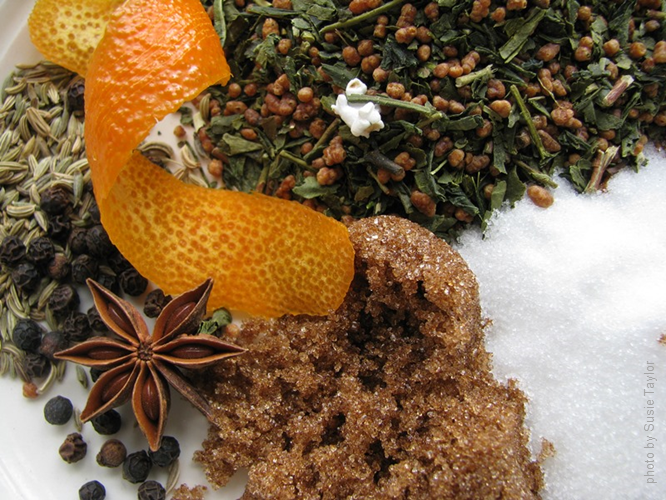
4 tbsp genmaicha tea (or 2 tbsp loose leaf green tea + 2 tbsp uncooked rice)

1 tbsp demerara sugar
1 tbsp granulated sugar
1 star anise
1/2 tsp fennel
1/2 tsp peppercorns
1 twist of orange

For serving:

a couple slices of stale bread
butter***
quick-pickled red currants****

***Or olive oil or bacon grease or drippings...

****Any berry from your freezer will do, the tarter the better.


MAKE AHEAD: You probably don't want to be running around like a crazy person feeling harassed and frustrated on Valentine's Day.  So make the smoked cod and the quick-pickled currants the day before.  We did a one-quarter-ish recipe of the Pickle Girl's recipe (link above) for the currants... and used the excess brine and pickled some wild blackberries to eat with cheese.

You need a heavy dutch oven or casserole or other pot with a lid.  You also need a good bit of aluminium foil and a heatproof rack that fits inside your pot.  We used our cast iron dutch oven and an old metal trivet with a bent leg (caribougrrl finally wins the why-are-we-keeping-all-this-useless-stuff game!).

When you see wisps of smoke rising from the tea mixture,
it's time to put the fish on.

Line your pan with tin foil in two directions, leaving a lot of overhang on all sides (enough to wrap the lid in later). Mix the tea, sugars, and spices together.  Spread these across the bottom of your foil-lined pan, add the orange peel, and place the rack over top.  Heat the smoking ingredients over medium-high until wisps of smoke begin to rise.  Put the fish on the rack in a single layer, put the lid on the pot, and wrap the lid with the overhanging foil.
Seal up the pot with tin foil turning it into a stove top smoker.


Let the fish smoke***** for about 12 minutes per inch of thickness.  You can tell if it's cooked the same way you would if you were baking or grilling it: the fish will be firm and fat will be coagulated on the surface.  White fish is delicate so remove it from the pan to cool rather than allowing it to cool in the smokey pan.

*****Your house is going to smell a bit smoky, but fragrant smoke, like incense.  Go ahead and run your exhaust fan, but there's a lot less smoke than you think, especially if you've used enough foil.  If you're still worried about it, take the whole pot outside when you open it up.


To serve:

Cut your stale bread into serving sized pieces.  For bonus points, cut it into heart shapes.  Butter (or oil or grease) lightly and fry in a skillet to toast.

Top toasts with flakes of smoked fish and a few pickled berries.  The bright and salty berries are the perfect counterpoint to the rich, smokey fish.


The tea-smoked cod is done when it's firm and flaky, and the fat has coagulated on the surface.

~~~

So, you might glean from the all the notes, that the important thing is not following the instructions exactly so much as using what you already have on-hand and following the idea.  Save your money for one good ingredient for your main or for a really good bottle of wine or for flowers, or (let's be honest) for your heating bill.  The point is, you can probably make something fantastic with things you already have sitting in your freezer and your cupboards.

About the tea-smoking.  We bought Skye Gyngell's A Year in my Kitchen several years ago and have always been tempted by the tea-smoking technique but really intimidated by it too.  When I saw the step-by-step in Showfoodchef's post about tea-smoked salmon, it all suddenly made sense and seemed accessible enough to try.  As it turns out, not only is tea-smoking possible, but it's surprisingly easy and surprisingly tidy.  Give it a try, you'll be amazed by yourself.

Stay tuned for a miniature version of a classic main, perfect for candle lit dinner.


11 January 2015

The Moose Curry Experience Best of 2014

We like to think we learn a few new tricks every year.  We certainly make an effort to.


Thanks to a good friend sending us bitters (some homemade!), we are beginning to really understand cocktails.  The Old Fashioned, however, wins the year.  


The Best 2014 Food Discoveries chez The Moose Curry Experience


As chronic gifted under-achievers, we're nearly late in getting our "best of 2014" list together, but here it is.  Our favourite new finds, new techniques and new solutions from the last year, in no particular order.


The Old-Fashioned

Curious about a note on Facebook, I asked an old friend, “Tell me about the bitters?!” to which he replied, “Check your mailbox in a few days.”  Much to our excitement (and sudden anxiety), a package containing homemade rhubarb bitters, homemade celery bitters, and some small-batch artisan-y orange bitters arrived at the post office.  Determined to do these justice, we bought better liquor than we might otherwise and did a lot of experimentation.  It feels like we are beginning to understand cocktails.  Which is as good a gift as the bitters themselves.

The complete winner though, is the Old-Fashioned...  made sacrilegiously with good floral single-malt scotch.  It was a complete and utter delight to discover that whisky can be as good in a cocktail as it is on its own.  Maybe even better in a cocktail.  Fefe likes the Old Fashioned because it can come with a maraschino cherry.  I like it because it smells like storm petrels.


Pho

Good lord, you can make pho at home!

It's what's pho dinner.  It's what's pho lunch.  It's even what's pho breakfast.  I can't think of the last time we had any leftover roast (other than fennel-rubbed pork, see below) where the carcass wasn't used for pho broth... plus all the pho broth Fefe has made from meat bought specifically for that purpose.

We had to go to Corner Brook in the late winter, not a place we would normally be thrilled to drive to in late winter, but we were looking forward to it because a Vietnamese restaurant had opened there a few months earlier.  I was dreaming of pho as the date approached.  Unfortunately, as the date approached, the restaurant was temporarily closed down and it didn't reopen until we were safely back across the island.  So disappointing.  But I couldn't stop thinking about pho.  Finally, while I was fighting a really nasty summer flu and could only breathe with difficulty out of one nostril, Fefe Noir took pity on me.  All I wanted was a bowl of chicken noodle soup, but specifically chicken pho so I could taste it.  She scoured the miracle of the internet pho recipes and it turned out to be a lot less mysterious and difficult than we expected.  So much so, it's part of our phoking repertoire now.

Za’atar

I want to ask, “How is it we’ve never used za’atar before?”, but I know the answer.  It may have existed for centuries in the middle east, but it did not exist in Newfoundland in any easily obtainable way until 2014.  Even if we’d known what we were missing before now, we couldn't have made it ourselves since sumac is impossible to find here*.

We’re in love though.  Za’atar on pita, za’atar on yogurt, za’atar on cottage cheese, in soups, in salad dressing, on eggs, dips, cooked veg, raw veg, meats of all sorts… it’s endlessly charming.

*I have a sneaking suspicion that some smug Newfoundland resident is going to tell me about some really obvious place that’s always carried za’atar and sumac.  Bring it on.  I’d like another source because the last time I bought some it was marked down to half-price, often a sign that it will disappear from the shelves forever.  I’d rather spend money right here than give it to someone somewhere else to have it mailed to me.

Grates Cove Studio Cafe

If you drive northwest-ish (as best you can following the road) from our home for long enough, all the way to the end of the road, you will arrive at the end of the earth, in a town called Grates Cove.   A place where you might find a cow tethered in someone's front yard, where there are days you can count more humpbacked whales in the coastal waters than people you will lay your eyes on.  

But as you are coming into the town, this astounding thing happens: the Grates Cove Studios Cafe.  And this is not any old cafe, it's a cafe serving Louisiana classics like gumbo and etouffe. Literally at the end of the earth.  Did I say that already? Not just gumbo either, sushi, Korean bbq and stromboli.  In rural Newfoundland! By far our best restaurant discovery of the year.


BBQ Pizza

Shockingly easy, and it really works.  Pizza can be cooked, right from the raw dough stage, on your propane bbq.

Not pizza with bbq sauce, but pizza made right there on the bbq grill.  We know other people have been doing this for a long time.  I have a reasonably clear memory of reading about it more than a decade ago in a magazine… I have a less clear memory of which magazine (Food & Drink? Martha Stewart? Canadian Living?). 

At any rate, the new-to-us technique traveled to us with some of our summer guests… during their road trip they stayed with someone who made it for them, then they made it for us.  Then we made it pretty much every week until it got too cold outside for sane people to be standing out at the grill.  However, I’m reluctant to suggest we’ll never be out there in unseemly weather... if we get a repeat of #DarkNL this year, bbq pizza could make the outdoor winter cooking list**.

**Fefe is not convinced of our ability to get dough to rise if we can't heat the house.  I'm working on a plan that involves tea light candles and the tiny tent we gave the cats for Christmas...

6-Minute Egg

What can I say?  It's a bit embarrassing for food bloggers to admit they didn't even know how to a boil an egg until well past their early 30s (there has to be a joke in there somewhere), but the 6-minute egg was something of a revelation.  Still soft, but custard-sauce-thick rather than runny yet, hard enough to be peel-able.

Soft-ish boiled eggs were obviously sexy in 2014; poached-in-the-shell and 6-minute boiled eggs seemed to be everywhere.  Eventually, Fefe tried the technique to do eggs to go into a spinach pie... when they stayed custard-like even with a second cooking, we were hooked.  Now we look for excuses to top things with egg.

Bring a pot of water to a boil, plunge your eggs in, boil for 6 minutes, remove to cold running water until just cool enough to handle, peel and they are ready for use. 

Fennel with Pork

Fennel has always gone into our pork meatballs wrapped in lemon leaves, because that’s what the first recipe we used did and it was delicious.  Somehow, that failed to sink into our minds as an epic pairing until we were watching the Jamie Oliver cooks frugally series and he rubbed a pork roast with fennel.  Suddenly it was all dings and flashing lights and air horns in our minds: pork and fennel.  Of course!  Duh.  And holey shirts, what a lot of fennel we’ve been through since that moment.

As a matter of interest, you can make an outstanding bean soup with the bones and scraps of a fennel-crusted slow-cooked pork butt.

A Cast-Iron Griddle

The cast iron griddle pretty much lives on our stove nowadays.  

We can cook more than one tortilla at a time!  More than one pancake!  Enough peppers and garlic for a big pot of romesco sauce.  All the peppers and tomatillos for a batch of salsa.  Bacon and eggs AT THE SAME TIME.  Bacon and eggs and toutons, if you like.  Or just an army of toutons. Moose sausage for all our friends and relatives (if one of our friends or relatives would give us some moose sausage...).  

And, if you turn it over, there's a grill we haven't even started to use yet.


NOMA Cookbook

The NOMA cookbook entered our home in the summer of 2014.  It is a beautiful thing.  There's an almost perverse sincerity oozing from the pages.. the earnest dedication to a food politic/ ethic/ morality in the essays.  Seriously beautiful photographs.  Paper that you want to spend your afternoon stroking because of it's genuine paper-ness.   

I will spend the next few decades flipping through this book being inspired to think more and more about food origins and locality.  I will expand my foraging and gleaning habits and pay more attention to the wildness of wild food.


I will never cook from this book.  


The NOMA cookbook recipes are beyond my comprehension; it's like the experimental jazz of cookery.  It will prod and poke and challenge, but I will always be chasing the tune rather than catching it.  I love it.


Solving the Mystery of the Wooden Spoon Handles

Over the last couple of years, our wooden spoons have disappeared one by one.  The spoon part, anyway.  No matter how diligently we made sure they were far back on the counter, no matter how well rinsed we kept them, eventually every last wooden spoon was decapitated.  We had our suspicions but careful monitoring of the, um, culmination of the digestive process in all our pets left no clues.  

But no spoon-ends appeared either, no matter how many appliances were pulled from the wall and cleaned out from under.

Shortly before Christmas, during marshmallow-making season, the culprit was caught in the act.  We are still suspicious he had some feline help getting the spoon from the back of the counter to the edge.  We now have a better system for idle wooden spoons (mason jars are a bit like duct tape as a general problem solver...).


The wooden spoon thief in his natural habitat.

10 August 2014

Newfound-Ceviche

We're at the tail end of the summer food fishery.  Put away your pans and deep fryers and let the last of your fresh cod cook itself in the refrigerator.


In this ceviche, the cod and scallop are cooked by the acid in the liquid.  That means you don't have to heat up your kitchen; a bonus during the dog days of summer.


Cod & Scallop Ceviche


1/2 lb fresh or thawed cod, chopped coarsely
1/2 lb fresh or thawed scallops, chopped coarsely*
3-5 cloves garlic, smashed and coarsely chopped
2-5 (or more) hot red peppers, cut in half lengthwise
1-1/2 c. chopped fresh cilantro
1 tsp coarse sea salt
4 limes, juiced
1/2 grapefruit, juiced
Use sea salt in this recipe because, well, the sea is where
the star ingredients come from.
2 tbsp silver tequila
Use glass or other non-reactive material.  Jars work well
because the high sides help reduce the amount of citrus
juice required to cover everything.

*if you use tiny bay scallops, don't bother chopping

Once all the prep work is done, this recipe is dead simple.

In a clean 1 litre glass jar** spread 1/5 of the cilantro, garlic and peppers over the bottom.  Top with 1/4 of the cod and scallops.  Add another layer of cilantro, garlic and peppers and 1/4 tsp of salt.  Continue to layer the fish and seasonings, ending with a seasoning layer.

**or use a glass bowl but you may need additional citrus juice to cover the fish; the tall narrowness of a jar helps minimize the amount of juice required... and with the price of limes this year, it's a definite advantage


Use a spoon handle or knife along the edges of the jar to
release pockets and bubbles of air.
Mix the lime and grapefruit juice with the tequila.  Pour into the jar.  This will cover or nearly cover your fish. Run a knife or spoon handle around the edge of the jar to release air bubbles.  If the fish mixture is not completely covered in liquid, add more lime juice.

Cover and refrigerate for 12-36 hours.  Check that the fish and scallops are opaque right through before serving (if not opaque, return to fridge for a few more hours).  How quickly the ceviche will cure depends on how cold your fridge is, how acidic your citrus fruit was, and how big your coarse chopping is.

Use a fork or slotted spoon to remover from jar and serve on grilled sweet potato slices (see below).

Reserve the curing liquid and mix it into fresh salsa the next day.


Grilled Sweet Potato Rounds


sweet potatoes 
drizzle of sunflower oil
pinch or two of salt


Discovering that sweet potato can be cooked directly on
the grill was a culinary epiphany of the best sort.
Pre-heat your grill scorching hot.

Slice sweet potatoes into 1/4" thick rounds.  Toss with oil and salt.

Put sweet potato rounds directly on the grill in a single layer and immediately turn the grill down to medium heat.  If you have a charcoal grill or are using a griddle, use your own judgement with how to manage this shift in heat, I have no advice.

Cook for 4-6 minutes on each side.  You want the outside to blister and char a bit and the potato to cook through.  Salt lightly as you take them off the grill.

These are perfect as a base for ceviche, but are also good as a side for pretty much anything (and a simple but seriously delicious way to get your orange vegetable for the day).


~~~


Although this is not exactly an authentic recipe, it's inspired by the Peruvian style of ceviche with hot peppers and served with sweet potato.  It's best with sweet potato, but grilled avocado will also do in a pinch...
~~~

Summer in Newfoundland is always busy.  For starters, you can never be sure how much of it you'll get, so as soon as the weather turns you drop everything else and concentrate on summer: coaxing food out of the back garden, outdoor house projects... running, cycling or hiking without multiple layers, driving with the windows down, synthesizing vitamin D... turning the heat off in the house (at least during the day), whale watching, cocktails on the porch... and most importantly, after months of complaining about the cold and the damp and the unfairness of it all, finally taking a deep breath and saying, "it's too damned hot".

The other thing about Newfoundland summer is that, as astounding as it may seem for the foggiest place on earth, this island in the north Atlantic is something of a vacation destination.  Some years, before you know it, you are blocked solid with visitors.***

***Now don't take that as a complaint.  Visitors give us the excuse to do touristy things and the opportunity to show off some of the off-the-beaten-path secrets of this place.  And conscripting house guests to a work-for-your-food scheme**** resulted in speedy progress on The Fence Project, a good start on The Window Restoration Project, and knocking a bunch of items off the Round-To-It List.

****That sounds a bit cruel, I suppose, but in the interest of full disclosure, these particular guests insisted they wanted a project to work on... 

This has been a Summer of Visitors, thus a summer of especially good food.  (We can't have it be said that anyone ate poorly chez The Moose Curry Experience.)  It's been tricky though, since the fish truck that used to live across the harbour closed a couple years ago and the fish truck we stumbled across last year did not reappear this spring.  We were scrambling to find seafood closer to home than St. John's*****.  After many driving excursions wild goose chases, a failure of the power of social media, and some disappointingly not-as-fresh-as-it-should-be purchases from big chain groceries, we finally found a place hiding right under our noses.  Some good old fashioned postering brought the recently opened Admiral's Market to our attention.  If you're in Conception Bay North, you can find them in the boat-shaped building at the southside marina in Harbour Grace.  Both the scallops and the cod used in this dish were bought from the fabulous women who run the market.


Fresh cod and fresh scallops were bought locally from Admirals Market.
*****There are some good fish shops in St. John's and since I work there, it's not always inconvenient, but it means not being able to decide on a holiday or Saturday that it feels like a mussel night... plus, there's something nice about being able to spend your money in the community where you live.

To be frank, I was hoping to write a blog post about catching our own cod during the food fishery.  But that's a one-that-got-away story.  Er, a one that never bit story.  (Anyone who wants to help improve some mainlander jigging skills in September should leave a comment or send an email to the.moose.curry.experienceATgmail.com!)

Although the cod fishing was a bust, it's been a Summer of Perfect Cilantro.  Serendipitiously, Fefe Noir had the foresight to order several pounds of coriander seed this year and sow it in the bed where we buried the not-quite-composted bits from the old composter.  As a result, we have a serious bumper crop of cilantro.  Despite the unbearable heat (for those of you who will take pleasure in mocking our weather intolerance, we had about 3 weeks in the mid-high 20C range), there was no massive bolting event.  


Our cilantro crop is phenomenal this year.  Too bad none of our guests were as enthusiastic about it as we are...

An amazing cilantro year.  And five or six weeks of guests who don't particularly like cilantro.  Or very hot peppers.  Or very much raw garlic.

So as soon as the house was empty we started chopping...