Showing posts with label cocktail. Show all posts

30 December 2014

The Most Wonderful Time of the Year

Sangria is one of the most delicious drinks of the holiday season.  Use white wine for a crisp, new-years-y feel.  


White wine sangria makes a great signature drink for your holiday cocktail party: fresh, crisp, boozy, and you can make the mix the day ahead.  Added bonus: fights scurvy...

Make-Ahead White Sangria Mix for your Holiday Party

Take advantage of the peak of citrus season and use fresh-
squeezed ingredients.

Get the mix ready the day before or the morning of your party.  

1 meyer lemon, sliced
1 lime, sliced
2 clementines, sliced
4 oz brandy
juice of 1-1/2 meyer lemons, 1 lime, 3 clementines

Put the sliced fruit in a pint-sized mason jar.  Add the brandy then top with the citrus juices.  This should almost exactly fill the jar.  Make up one jar of mix for each bottle of wine you anticipate turning into sangria.

Take a moment to marvel at how beautiful those jars of citrus fruit look, then put them in the fridge until you are ready to use.  (If it's a cold enough winter, you might be able to store them in your shed or a closed in porch... if you aren't sure, don't take the chance.)
~~~
Each pint-sized mason jar of citrus-brandy mix will do one 750 mL bottle of wine.  Use the jar to measure your sparkling lemonade, mix it all together and illico presto, you have sangria.

White Wine Sangria Instructions


Make sangria in a pitcher or punch bowl (depending on the size of your party and your aesthetic sensibility) with ice.  Since it's all pre-measured, you can start with as much as you want and easily top it up as needed. For each jar of sangria mix add:

1 bottle of crisp and bright white wine (like sauvignon blanc or pinot grigio)
2 cups* of decent sparkling lemonade**

*don't bother with a measuring cup, just fill your empty mix jar to the neck
**this saves you from having to make a syrup and figure out the right ratio of syrup to soda water, and still lets you avoid the HFCS pitfall of most soda pop 

...give it a stir and you're on! 
~~~

[Hi, Mom!  You can skip this paragraph, I won't be offended...]  A million years ago when we were undergrads living in a student apartment with a then-new-friend who is a now-old-friend, we had the occasional sangria party: everyone brought a bottle of cheap red wine and piece of fruit.  A big bucket was filled with the various wines of suspect origin, some cheap brandy or maybe whisky (or whatever was handy) was tipped in, grapefruit-ish Wink soda to dilute and sweeten, and masses of uncoordinated fruit were chopped and tossed in for good measure.  When the sangria ran out and the fruit mostly consumed, anyone left standing was likely to go out for breakfast.  This bucket-of-sangria fun, I must point out, was started by previous tenants of that apartment long before we moved in... a tradition that was inherited with the apartment.  A tradition that should undoubtedly stay with the apartment, because anyone over the age of 25 is probably not immortal enough for the consequences of such an event.

If I recall correctly, sangria parties were generally spring events, something to help shake off the long cold winter.  So for the longest time, I thought of sangria as a spring or summer drink.  Bubbles, fruit, ice... what's not summery about that? 

But, lo and behold, I was wrong.  

A few years ago, I was talking warm weather drinks with a Portuguese-immigrant friend who found it amusing that I associated sangria with summer because, so far as she is concerned, sangria is for Christmas.  What an epiphany!  Even without thinking too hard about it, I am happy to defer to the Portuguese on this.  

But think about it anyway: of course sangria is a Christmas drink.  Citrus is available year-round, but December is when it’s at its peak season.  It’s the time of year we buy crate after crate of clementines and the end of the season for boxes of mandarins wrapped in thick purple paper.  Meyer lemons and early blood oranges appear on the shelves, limes become so inexpensive you can buy them in dozens without having a panic attack at the till, and heavy boxes of grapefruit pre-ordered as fundraisers for school bands finally materialize.  It’s the most wonderful time of the year indeed.

So make sangria during the holiday season.  (In a pitcher or punch bowl.  No buckets.***)

***Unless, of course, you are a student... 

And a happy new year!

The advantage of fresh but pre-measured sangria mix could become abundantly clear as
the evening progresses... 

26 May 2014

The Oldest Cocktails You'll Ever Drink

When Fefe Noir and caribougrrl go foraging for prehistoric water, it's just the tip of the iceberg...


It's a brilliant year for icebergs in our neck of the woods.  The more icebergs that drift down from Greenland, the more likely we are to find bits and pieces washed up on shore.

Along some parts of Newfoundland's coast, collecting iceberg pieces to use for cold drinks or to melt for fresh water is an annual ritual.  Down here in the southeast corner of the island, availability is a bit more hit and miss.  It's a good year for icebergs, so we've been scouring the coast for washed up ice and undertaking the terrible job of testing cocktail recipes worthy of ancient ice cubes.

Starting with the obvious ingredient of locally brewed Iceberg Beer (if you can't find this, substitute with a mexican lager), we bring you two cocktails perfect for drinking on the porch after mowing the lawn.


This beer-garita (left) and michelada (right) are made made with beer brewed with iceberg water and chilled with a few hunks of iceberg in the glass.


Iceberg Beer Michelada

sea salt
Use an ice pick or a chisel to crack up the iceberg bits.
small hunks of ice chipped from an iceberg
juice of 1/2 lime
juice from 1/2 small sweet orange (like a satsuma or clementine)
2 tsp jalapeno syrup
most of a bottle of iceberg beer

Salt the rim of a tall glass.  Fill glass with ice. Add the other ingredients in the order they are listed, give it a quick stir and garnish with citrus wedges and sliced jalapeno.
Both cocktails are salty and spicy.  The tequila gives the
beer-garita (left) a bigger kick.  The orange juice sweetens
the michelada (right) just enough to temper the salt.


Iceberg Beer-garita

sea salt
small hunks of ice chipped from an iceberg
juice of 1 lime
3 tsp jalapeno syrup
3/4 oz. silver tequila
iceberg beer

Salt the rim of a tall glass and fill with ice.  Add lime juice, tequila and syrup.  Give it a gentle stir then top up with beer.  Garnish with slices of fresh jalapeno and a wedge of lime.


~~~


(Ground-based) Iceberg Foraging and Handling


If the tide and currents are just right, you might come across a beach littered with car-trunk sized pieces of iceberg.  These are small in the grand scheme of an iceberg life, but they can be rather awkward to lug around.  Not only are they hard to get your arms around, but they're slippery as all get out.

The icebergs we see along the Avalon peninsula in the
southeast of Newfoundland have traveled about 3000 km
on their trip from western Greenland.
Foraging for usable iceberg pieces is serious business when you don't have a boat.  (We don't have a boat.)  You have to find bergy itty-bits that are big enough to make it worth the effort of bringing them home, but small enough you can wrangle them from the beach to the trunk of your car.  You are also confined to accessible beaches, and the tides and bergs are not always cooperative.

As the icebergs melt and crack and fall apart, small pieces
sometimes drift close enough to shore to capture.
Go for a drive, sticking to coastal roads.  Try not to be distracted by the spectacular view of gigantic, prehistoric, hunks of ice floating around willy-nilly in the ocean.  Be aware of them though, because they are a good sign that you might find some washed up bits, particularly when there are trails of broken up bits and pieces drifting toward shore.

The first day we went out looking for beached iceberg was the hottest day we've had yet this year.  The sun was shining, it was warm enough to wear short pants, and it was the Saturday of a long holiday weekend.  The holiday weekend when people head out to their cabins and summer homes for the first time in the year.  The holiday weekend at the beginning of tourist season.  There were people everywhere.  Every tiny, barely used side road, every dirt track down to a beach, every lookout.  But not one hunk of ice washed up... at least not one that has survived the eye of other iceberg foragers.

So here's another tip:  go out on a cold, foggy day.  Less competition.


To increase your chances of being the person in the right place at the right time, go iceberg foraging on cold, foggy days when the competition is low.
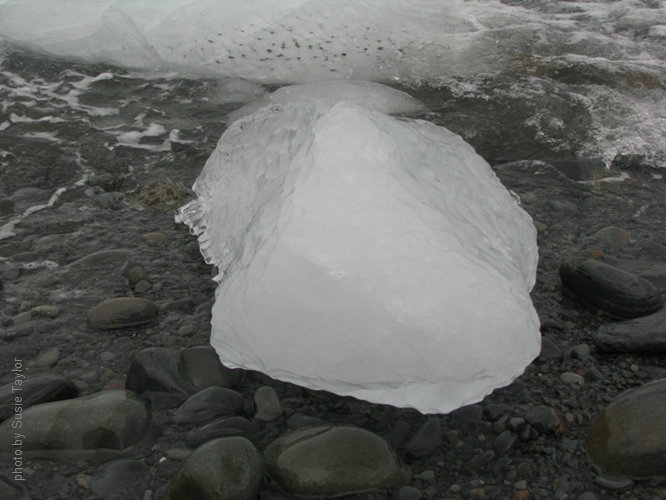
When you do find washed up ice on a beach you can get to, you want to be sure it's iceberg ice and not annual sea ice.  The pressure of thousands of years of snowfall accumulation results in a very hard ice, much harder than what's in your ice cube trays at home (sea ice is comparatively soft).  Most strikingly, iceberg ice is filled with tiny bubbles.  The same way the ice is made from water which froze 12,000 - 100,000 years ago, those bubbles are filled with air from the same time period.  Prehistoric water, prehistoric atmosphere. 


All those tiny bubbles in the ice are what make icebergs
appear white in colour.  They also contain air from tens
of thousands of years ago when the ice formed.
Despite all that air, the ice is heavy, so remember to lift with your legs.  If you have a pair of gloves handy, this will make the trip back to the car with your armload of ancient ice more comfortable.  You will get wet.  Waves will inevitably wash over your feet while you are wrestling the ice up to the tide line.  Your shirt will be soaked from carrying the berg, because, well, it's wet to begin with, and your body heat is enough to melt it a bit while you lug it.  So either wear your rubber boots and rain suit, or consider the frozen wetness a hazard of doing business... part of immersing yourself in the experience.

(Your mother-in-law's job during iceberg foraging trips is, apparently, to provide helpful advice from the back seat of the car.  She will be worried about your wet shirt.  Pay her no mind, it's not actually possible to catch the flu from an iceberg.  Also, unless you only took fist-sized pieces, she is wrong about it melting before you get home.)


If you wade out at all to retrieve ice, bear in mind that the water is still really cold this time of year.  Unless you're geared up with insulated waders, don't stand in it for too long.  Even prehistoric ice in your drink is not worth hypothermia.


Once you get it home, let the ice sit out for several hours to shed the salty seawater and any other surface contaminants.  If necessary, use a hammer and chisel to break it into hunks which will easily fit in your freezer.  Wrap well and freeze until needed.  Use the chisel again (or an actual ice pick) to break into drink-sized hunks.

If you want iceberg water, chisel into pieces small enough to maneuver into food-safe containers and leave it out to melt.  Bearing in mind that we've stopped heating the house because it's May (never mind that it's only a few degrees above freezing out, I'm in winter-denial): a large saucepan filled with iceberg pieces took nearly 3 days to melt completely, but there was enough for a pot of coffee by the time a day was gone.


~~~

Why bother with icebergs?  

There's something incredibly compelling about knowing you are holding the air and water that existed tens of thousands of years ago.  If you buy the local propaganda around iceberg products, this is water in it's purest form.  The scientist in me would argue that distilled water should be more pure, but there's no romance in distillation.  To be fair, this ice was formed before humans started burning petrochemicals and tossing plastic into the ocean, so the air and water is untainted by the industrial age.  I'm willing to forgive a bit of volcanic ash and some woolly mammoth farts captured in the Greenland glacial sheet, and think of it as the cleanest water available.  Plus, it's really really old, and that's just super cool. (Heh.  Get it?  Super cool...)
Get some really good coffee beans and use iceberg water
to brew up what might be the best cup of coffee you'll ever
drink.  

Definitely use the ice in cocktails. For one thing, it's a great conversation starter at a party.  For another, it's an excellent way to show off in front of your friends.  But also melt some water out and make coffee with it.  Trust me, it makes a seriously good cup of coffee.  Do NOT, however, waste iceberg water on Folgers or Maxwell House.  Go out and buy some really good coffee, in the form of fresh-roasted beans and grind it yourself.  Serendipitiously, we recently won some great coffee from Got My Beans through a The Food Gays giveway... definitely iceberg-water-worthy.

Choose ice that is small enough to handle, but big enough to be worth the effort of  the expedition.  After that, the choice is arbitrary.  This one reminded me of Tiktaalik emerging from primordial soup.  I left it because, well, it's creepy.
One of my all-time favourite Newfoundland words is "maggoty" and although the Dictionary of Newfoundland English will tell you the word refers primarily to salt cod which is full of blow-fly maggots, I've never heard it used to refer to actual maggots.  In my experience, it simply gets used to express that something is riddled with something else.  St. John's is maggoty with tourists in the summer.  The coast is maggoty with icebergs.

And it is, this year.  Maggoty with 'em.  The icebergs.  We're having a crummy, cold spring (minus that one Saturday), but it's a spectacular year for bergs.  Drop everything else and take advantage of it.


The best time to visit Newfoundland if you are hoping to see icebergs is during May and into early June.  

31 October 2013

Halloween for Grown Ups

Halloween is exhausting for kids and grown ups alike.  But the kids end the night in a sugar low, passed out clutching a big bag full of candy.  What do the grown ups get?  With a little bit of planning, a really good scotch whisky cocktail, that's what.


Peppy Scotch & Lime


2 ice cubes
1-1/2 oz ginger and black pepper infused scotch (see below)
juice of 1/2 lime

Pour scotch over ice, top with lime juice, stir once to lightly mix.  Better than a scotch and lime because it's gingery and peppery.  Better than a whisky sour because it's dry.  


Ginger and Black Pepper Scotch

6 black peppercorns
5 very thin slices fresh ginger (or more, or less to taste)
6 oz. blended scotch

A good blended scotch is better than a crummy single malt.  Plus, infusing a blend is somehow less sacrilegious than infusing a single malt.  Just don't use a crummy blend, there's no point to it.

Place the peppercorns and ginger in a clean jar; pour scotch in.  Cap with a tight fitting lid and store in a dark place for 36-48 hours.  Strain into a second clean jar to remove ginger and pepper.  Voila!  Fait accompli.  Now make a drink.

~~~

Rushing to open the door before anyone knocks so that the dogs don't start barking like a pack of ferocious cerberus every time children approach the house.  Kids wrinkling their noses at nature's candy.  (Kidding, really, caribougrrl is no longer permitted to hand out dried fruit and cheese sticks.)

"I'm not a fairy!  I'm a fairy princess."

"Can I get an extra one for my dad?"

"I'm allergic to those."

"Want to see me do my frog dance?"

"My brother is a devil without the costume too."

"Do you have anything bigger than that?"

"I'm a cat princess, silly."

"Don't you even know who Optimus Prime is?"

"Noooooooooo!  I'm Snow White The Princess."

"Want to see my other frog dance?"


How many times did you have to pick up that big bowl of candy from the bench in the front hall?  You absolutely deserve a drink.

23 June 2013

Three Cheers for Rhubarb!

One batch of rhubarb cordial turns into three summer drinks.  Perfect for warm evenings on the front porch.


From the Left: The Rhubarb Sangria, The Rhubarb Royale, and The Rhubarb Daiquiri.  One batch of rhubarb cordial provides the extra-special not-so-secret ingredient for all these drinks.

The Rhubarb Daiquiri

(for a pitcher)
1/2 c. freshly squeezed lime juice
1-1/2 c. rhubarb cordial (see recipe below)
1 c. amber rum

(for an abstemious single drink)
1 oz. freshly squeezed lime juice
3 oz. rhubarb cordial
2 oz. amber rum

This is not the over-sweetened slushy stuff you get at Thank God I Don't Work Here on two-for-one Tuesdays.  We have provided the measures for a single daiquiri, but make a pitcher.  Really, make a pitcher.  This is a rock star of a drink.  

Mix all the ingredients in a glass pitcher sometime in the afternoon, like just before you weed your garden or take your dogs for a long walk.  Chill in the refrigerator.  Rim serving glasses using a wedge of lime and dredging in sugar (we like a martini glass for this).  Put the glasses in the freezer.  Go do something outside for a couple of hours.  Give the daiquiri a stir before pouring into chilled glasses and enjoy.  Here's the good news: because you made a pitcher, there's another one waiting for you.


The Rhubarb Royale

(per single serving)
1 oz. rhubarb cordial (see recipe below)
3 oz. dry white cava

Pour one ounce of rhubarb cordial in the bottom of a champagne flute, top up with cava (about 3 oz.).  Garnish with a curl of fresh rhubarb (a carrot peeler works perfectly for this).  You could, of course, substitute champagne or other sparkling white wine for the cava, but why would you?  Cava is a beautiful bubbly, made in the same method as champagne and is substantially less expensive than similar-quality french champagnes.  

When we were moving from Ontario to Newfoundland, we took our time driving out.  In Nova Scotia, we spent a few days at Risser's Beach Provincial Park, taking a break from the road, picking up sand dollars in the surf, and making ridiculously pretentious meals on our campfire (like fire-roasted beetroot and goat cheese salad).  One day when we were too hot and tired for cooking, we drove down the road to MacLeod's Canteen and had fish & chips (some of the best fish & chips we ever ate, incidentally) and rhubarb fizz.  We went back the next day for more rhubarb fizz.  We are fans of fish & chips (who isn't?) but the rhubarb fizz completely stole the show, and we talk about periodically even now, 11 years later.  The Rhubarb Royale is a grown-up (that is, alcoholic) tribute to that rhubarb fizz on the beach.


Hey... where did this cat come from?
The Rhubarb Sangria

1 c. rhubarb mash (by-product of rhubarb cordial, see below)
1/2 c. brandy
1/2 c. freshly squeezed orange juice
1 bottle cheap red Spanish wine   
orange wedges for garnish
ice cubes

In a blender, puree rhubarb mash and brandy.  Pour rhubarb-brandy mixture into a glass pitcher or carafe (the container needs to be able to handle 1.5 liters of liquid).  Let the flavours mingle for a little while (long enough to fold a load of laundry or do some dinner prep work).  Add orange juice and red wine to the pitcher, stir thoroughly.  Serve over ice in red wine glasses or tumblers, garnished with a wedge of orange.

Use an inexpensive red wine for this, but not one that will leave you with a headache. So pick a red wine you might drink on it's own, but stick to the lower price range that you typically buy from (we used a temperanillo).  The rhubarb matches the wine for flavour and there's a lovely subtle burn from the brandy; altogether a beautiful way to boost your fiber intake and get a good dose of antioxidants; not to mention all that vitamin C between the rhubarb and the orange juice.  Oh yes, we're totally selling this to you as a health-food... 


How to Make a Ridiculously Easy Rhubarb Cordial


recipe adapted from Eat Like a Girl

2 lbs. rhubarb, chopped roughly (thumb-sized hunks)
1-1/2 c. water
1 c. (scant) sugar

Combine rhubarb, water and sugar in a heavy bottomed saucepan.  Bring to a boil over medium heat and cook for about 15 minutes, until rhubarb is softened and has broken down and become stringy.  The sauce should be slightly reduced and thickened.  Stay in the kitchen while the rhubarb is cooking and watch your pot -- it can boil over suddenly if you aren't paying close attention (ask me how I know).  Remove from heat and let cool about a half hour (hey, that's enough time to read a couple chapters of that book you are trying to finish!).


Left: Rhubarb chopped into thumb-sized pieces.  Right:  The thick stringy stew ready for straining.
Strain the liquid into a jar or other suitable glass container:  this is the cordial, congratulations, it really is that easy.  The cordial will keep refrigerated for about a week.  If you want to save some for later, freeze in ice cube trays or other appropriate-sized containers then transfer the frozen blocks to freezer bags to make your freezer space more flexible.  Reserve the rhubarb mash for sangria (above) or to use in smoothies in the next couple of days.  


Most cordial instructions tell you to use a jelly bag for straining.  We bought a jelly bag a few years ago and used it exactly once:  for some reason, jelly bags are cat hair magnets, so it didn't last long in our house.  We use a drip coffee system for straining cordials, jellies and such the like, and have found it has a couple of advantages.  Firstly, the gold mesh filter does not seem to capture cat hair.  Secondly, there is not need for creating a complex string and weights hanging system; you just set the filter on top of your jar and don't worry about it.  Plastic drip holders and filters come in a couple of sizes (mug sized and coffee pot sized), are pretty inexpensive and a lot less messy than mucking around with muslin or jelly bags.  


Three cheers for rhubarb! on Punk Domestics
my photos on tastespotting

30 May 2013

The Dandelion Martini


2 oz. dandelion-infused vodka (below), straight from the freezer
3 dandelion capers, it has to be 3, because 3 is sexy

Pour vodka into martini glass, garnish with capers.
Best served in the middle of your dandelion-infested lawn.  Drink and think about the diaspora of dandelion through the known universe.


The dandelion infused vodka was adapted from Dazed and Infused's recipe.

Pour an inch of vodka in the bottom of a clean, dry, mason jar.  Use good vodka for this. Cheap vodka is for Ceasars and teenagers.  If it comes with a free hat, it's cheap.

Pick two really big handfuls of dandelion flowers, carefully avoiding bugs, then chop the green end off, pull the yellow fluffy part out.  The yellow fluffy part goes in the jar with the vodka; keep adding yellow fluff until the jar is about 2/3 full.

Top up with vodka.  Leave on the counter near a window for 2 days (if you live in a warm sunny climate) or 3 days (if you live in Newfoundland).  Put it in the fridge to make it a week. On day 7, strain into a new clean jar and store in the freezer.

Once it's good and cold, go ahead and make that martini.


~~~

Since Dazed and Infused doesn't have tasting notes for this, here's what we thought of it:  totally drinkable.  Fefe thought it had a sweet note... she described it as floral-y and nectar-y.  caribougrrl thought the taste was reminiscent of very very ripe cantaloupe   Fefe continues to drink dandelion martinis, caribougrrl is happy to leave it in the freezer.


Dandelion Martini on Punk Domestics